
Evaluate
The Four Drivers Framework: Understanding How Life Is Actually Being Lived
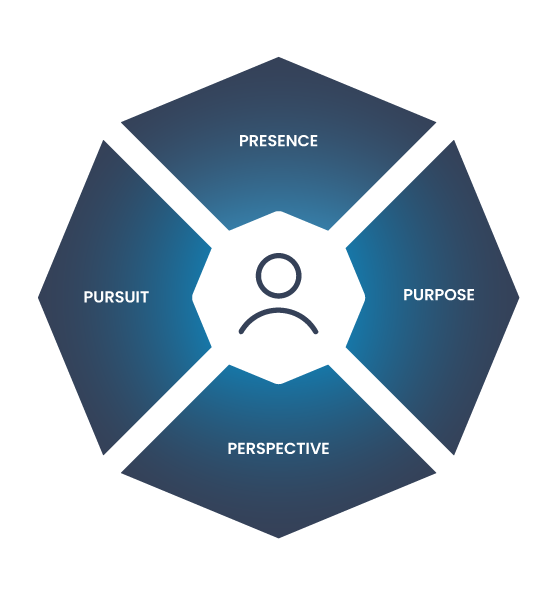
The Four Drivers - Presence, Purpose, Perspective, and Pursuit - are dynamic conditions that describe how life is being experienced and directed at any given time. Developed as part of Fathom's personal development system, the Drivers framework diagnoses imbalance by making invisible life dynamics visible, replacing vague dissatisfaction with clear, actionable signals.
Unlike personality traits or values, Drivers are not fixed. They rise and fall depending on your attention, choices, habits, and circumstances. Most dissatisfaction is not caused by lack of capability or opportunity - it is caused by Driver imbalance. You may be striving relentlessly but never enjoying (high Pursuit, low Presence). You may feel comfortable but directionless (high Presence, low Purpose). The Drivers framework exists to identify these patterns and guide recalibration.
The framework integrates insights from Stoicism, Buddhist psychology, existential philosophy, and modern behavioural science into a single applied system. Rather than treating these as separate traditions, Fathom treats them as interacting forces that must be held in conscious balance. Research in positive psychology supports this approach - a 2023 meta-analysis published in the Journal of Positive Psychology found that individuals who maintain balance across multiple wellbeing dimensions report 34% higher life satisfaction than those who excel in only one area.
Within the Fathom personal development system, Drivers sit at the experiential centre of Evaluate Mode. Traits influence how easily each Driver is accessed. Values determine which Drivers feel meaningful. Principles govern how Drivers are expressed. And Habits strengthen or weaken Drivers over time.
By Dan Ford · August 2026
The Article
Drivers
What Are the Four Drivers?
The Four Drivers are Presence, Purpose, Perspective, and Pursuit. Each Driver represents a fundamental dimension of lived experience, and each is composed of two inseparable components that work together. Fulfilment is not achieved through maximising any single Driver - it emerges when all four are consciously engaged.
Think of Drivers as a diagnostic instrument. They answer a single question: How is life actually being lived right now? Not how you wish it were being lived. Not how it looks from the outside. Drivers reveal the gap between intention and experience - and that gap is where most meaningful personal development begins.
The four Drivers and their eight components are:
- Presence - Gratitude and Appreciation
- Purpose - Intention and Impact
- Perspective - Mindset and Challenge
- Pursuit - Aspiration and Action
Driver 1: Presence - Living the Present Fully
Presence reflects your ability to be engaged with and receptive to the present moment, rather than living primarily in anticipation of the future or rumination on the past. Presence is not complacency - it is the capacity to experience life as it is while still choosing to grow.
Research in contemplative psychology consistently demonstrates the importance of present-moment awareness. A landmark study by Killingsworth and Gilbert at Harvard found that people spend approximately 47% of their waking hours thinking about something other than what they are currently doing - and this mental wandering consistently predicts lower happiness, regardless of the activity.
Presence is composed of two components:
Gratitude is the recognition of what already exists - what is working, what has been received rather than earned. High Gratitude shows up as emotional steadiness, reduced comparison, and an ability to acknowledge progress. Low Gratitude shows up as chronic dissatisfaction, entitlement, and "I'll be happy when..." thinking. The common distortion is mistaking gratitude for settling or lack of ambition.
Appreciation is the ability to value, savour, and fully experience what is present - people, moments, progress, and effort. High Appreciation shows up as enjoyment of the process, deeper relationships, and richer lived experience. Low Appreciation shows up as emotional numbness, inability to enjoy success, and constant mental projection into the future. The common distortion is confusing appreciation with indulgence or passivity.
Presence stabilises the entire system. Without it, progress feels hollow and life becomes a perpetual waiting room - always arriving, never arrived.
Driver 2: Purpose - Meaning Through Direction and Contribution
Purpose reflects your sense of direction, meaning, and chosen responsibility - expressed through what you aim toward and the impact you seek to create. Purpose is not a fixed mission statement. It is an active orientation toward meaningful engagement that evolves as circumstances change.
Viktor Frankl's research on meaning, developed during and after his experiences in Nazi concentration camps, established that a sense of purpose is among the strongest predictors of psychological resilience. More recently, a 2019 study published in JAMA Network Open found that adults with a strong sense of purpose had a significantly lower risk of all-cause mortality, independent of other known risk factors.
Purpose is composed of two components:
Intention is clarity of direction - why you are acting, what you are orienting toward, and what you are consciously choosing to prioritise. High Intention shows up as clear direction, aligned decision-making, and reduced internal conflict. Low Intention shows up as drift, reactive choices, and confusion between effort and progress. The common distortion is mistaking vague aspiration for genuine commitment.
Impact is the sense that your actions create meaningful difference - for yourself, others, or the wider world. High Impact shows up as motivation grounded in contribution and sustained engagement. Low Impact shows up as emptiness, cynicism, and loss of meaning even when busy or successful. The common distortion is chasing visibility or scale instead of genuine contribution.
Purpose provides meaning and direction. Without it, comfort becomes stagnation and effort loses significance. In Deci and Ryan's Self-Determination Theory, purpose aligns closely with the fundamental human need for autonomy and competence - the sense that your actions matter and are freely chosen.
Driver 3: Perspective - How Experience Is Interpreted and Engaged
Perspective reflects how you interpret events, challenges, and uncertainty - and how you choose to engage with difficulty. Perspective does not remove hardship. It determines how much hardship limits growth.
Carol Dweck's research at Stanford on fixed versus growth mindsets demonstrated that individuals who believe abilities can be developed through effort consistently outperform those who believe abilities are innate, particularly when facing setbacks. The Stoic philosophers arrived at a similar insight two millennia earlier - Epictetus observed that it is not events themselves that disturb people, but their judgements about those events.
Perspective is composed of two components:
Mindset describes your underlying beliefs about capability, learning, and change. A growth-oriented Mindset shows up as learning from setbacks, adaptability, and reduced fear of failure. A fixed or constrained Mindset shows up as defensiveness, avoidance, and identity-based collapse after failure. The common distortion is using "growth mindset" language to deny genuine limits or responsibility.
Challenge reflects how you relate to difficulty - whether you engage with it deliberately or avoid it reactively. Healthy engagement with Challenge shows up as willingness to stretch, constructive risk-taking, and progress through friction. Avoidance of Challenge shows up as stagnation, rationalisation, and over-reliance on comfort or safety. The common distortion is confusing challenge with suffering or self-punishment.
Perspective protects momentum. Without it, setbacks derail progress and emotions dictate behaviour. In the context of career resilience, Perspective is often the Driver that determines whether professionals adapt to disruption or are paralysed by it.
Driver 4: Pursuit - Deliberate Movement Toward the Future
Pursuit reflects your orientation toward the future - the degree to which you are reaching for something meaningful and energised by what is approaching. Pursuit is not hustle. It is purposeful forward engagement - the internal conditions that make sustained movement possible.
Research on goal pursuit consistently shows that the combination of vision and positive future orientation predicts achievement more reliably than talent, motivation, or circumstance alone. Angela Duckworth's work on grit found that sustained effort toward long-term goals was twice as predictive of success as talent in contexts ranging from military training to academic achievement. Crucially, grit requires both the aspiration to reach for something bigger and the consistent action that sustains momentum through difficulty.
Pursuit is composed of two components:
Aspiration is the capacity to imagine, desire, and orient toward a meaningful future. High Aspiration shows up as vision, possibility thinking, and long-term orientation. Low Aspiration shows up as resignation, cynicism, and short-term survival thinking. The common distortion is aspiration without grounding in reality or values.
Action is the consistent translation of aspiration into behaviour - the follow-through that turns intention into visible progress rather than leaving it as thought. High Action shows up as concrete steps taken toward goals, follow-through on commitments and more time spent doing than deliberating. Low Action shows up as plans that never start, intentions that stall and a widening gap between what is wanted and what is done. The common distortion is mistaking motion or busyness for genuine progress toward what matters.
Action creates a natural tension with Aspiration. Aspiration orients you toward a meaningful future; Action turns that orientation into daily behaviour. Too much Aspiration without Action produces vision that never becomes reality. Too much Action without Aspiration produces motion without meaning - effort disconnected from what genuinely matters. The interplay between these two components is one of the most important balances in the Pursuit Driver.
Pursuit creates progress. Without it, potential remains unrealised and clarity decays into contemplation. In Fathom, Habits are the primary mechanism through which Pursuit is operationalised - they convert aspiration and action into repeatable, trackable behaviour.
Why Do the Drivers Matter? Diagnosing Imbalance
The Drivers framework exists because most dissatisfaction is not caused by a single problem - it is caused by imbalance between Drivers that are individually healthy but collectively misaligned.
Common imbalance patterns include:
High Pursuit, Low Presence - constant future-orientation with no enjoyment of the present. Life feels like an endless treadmill of action and aspiration without arrival. Achievement approaches but satisfaction does not. This pattern is especially common among high-performing professionals who have optimised for career ambition at the expense of present-moment experience.
High Presence, Low Pursuit - comfort without direction. Life is pleasant but stagnant. Days pass easily but years feel wasted. This pattern often emerges after burnout, when the recovery from excessive Pursuit swings too far toward inaction.
High Purpose, Low Perspective - idealism without traction. Strong convictions undercut by an inability to navigate setbacks or adapt to reality. This pattern often produces frustration, moral rigidity, and eventual disillusionment.
High Perspective, Low Purpose - insight without direction. The ability to reframe and adapt without a clear sense of what to move toward. This pattern produces sophisticated analysis but minimal progress.
The aim is not symmetry or equal scores. It is situational balance - the awareness of which Drivers need attention now, given your current circumstances and priorities.
How Drivers Connect to the Rest of the Fathom System
Drivers do not operate in isolation. They interact with every other component of the Fathom personal development system:
Traits influence how easily each Driver is accessed. Someone high in Neuroticism may find Presence more difficult to sustain. Someone high in Openness may access Perspective more naturally. Traits explain resistance and ease - they do not determine outcomes.
Values determine which Drivers feel meaningful. If you value Security, Pursuit may feel threatening. If you value Achievement, Presence may feel like wasted time. Understanding your values prevents misinterpreting natural Driver preferences as character flaws.
Principles govern how Drivers are expressed in daily decisions. A Presence-based principle might be: I do not rush important conversations. A Pursuit-based principle might be: I act before I feel ready.
Habits strengthen or weaken Drivers over time. A daily meditation practice builds Presence. A weekly review builds Perspective. Habits are the behavioural mechanism through which Drivers are maintained - they translate the internal conditions diagnosed by Drivers into observable, trackable execution.
Tasks register the experiential cost of a neglected Driver. Chronic low Presence often has a mundane cause: a week of tasks with no slack and no allocation logic. The Drivers assessment reveals the symptom; how your hours are actually spent usually contains the cause.
Pillars describe where Drivers are being expressed. You may have strong Pursuit in your Work Pillar but weak Pursuit in your Wellbeing Pillar. Drivers operate within and across all six life domains.
Strengths determine whether Driver engagement is structurally viable. Weak Strengths (insufficient Resources, eroded Relationships, declining Relevance) can make it impossible to sustain any Driver regardless of intention.
How to Use the Drivers Framework: Practical Application
The Drivers framework is designed to be used regularly as a diagnostic tool, not a one-time assessment. Here is how to apply it:
Step 1: Honest Assessment. Rate each of the four Drivers on a simple scale. Where does your attention and energy currently sit? Which Drivers feel strong? Which feel neglected? Fathom's built-in assessment tools guide this process, but even a simple self-reflection is valuable.
Step 2: Identify the Imbalance Pattern. Look for the common patterns described above. Most people will recognise one dominant pattern immediately. The pattern itself is not the problem - the lack of awareness is.
Step 3: Strengthen the Neglected Driver. Rather than trying to maximise every Driver simultaneously, focus on the one or two that are most neglected. Small, consistent shifts in attention and behaviour produce meaningful change. If Pursuit is weak, ask whether it is Aspiration (no vision) or Action (aspiration not translating into consistent behaviour) that needs attention - the intervention is different for each. Assign specific Habits to support the neglected Driver.
Step 4: Design Principles Around It. Create one or two Principles that govern behaviour in the neglected area. If Presence is weak, a principle like I protect focus over busyness creates a decision rule that reinforces the Driver daily.
Step 5: Reassess Regularly. Drivers fluctuate. What is balanced today may shift in a month due to a career change, a relationship shift, or a health event. Revisit your Driver assessment at regular intervals - Fathom recommends monthly as a baseline.
The goal is not perfection. The goal is awareness, followed by intentional calibration. Fulfilment is not achieved by intensity or comfort alone, but by deliberate calibration across Presence, Purpose, Perspective, and Pursuit.
The Philosophical Roots Behind the Four Drivers
The Fathom Drivers Framework integrates long-standing human insights from multiple wisdom traditions into a single applied system:
Stoicism contributes the emphasis on agency, intention, and engagement with what is within your control. The Stoics understood that how you interpret and respond to events matters more than the events themselves - a principle embedded in the Perspective Driver.
Buddhist psychology contributes the emphasis on present-moment awareness, appreciation, and non-attachment. The Presence Driver draws directly from contemplative traditions that have recognised for millennia that the inability to inhabit the present moment is a primary source of suffering.
Existential philosophy contributes the emphasis on meaning, responsibility, and chosen direction. Kierkegaard, Frankl, and Camus all explored the human need for purpose - not as something discovered but as something created through commitment and action.
Modern psychology contributes the emphasis on mindset, motivation, goal pursuit, and behaviour change. Dweck's mindset research, Duckworth's work on grit, and Deci and Ryan's Self-Determination Theory all inform how the Drivers framework connects psychological insight to practical application.
Rather than treating these as separate intellectual traditions, Fathom treats them as interacting forces that illuminate different dimensions of the same human experience. The integration is the innovation.
Start Understanding Your Drivers
The Drivers framework is one component of Fathom's integrated personal development system - a structured approach to self-understanding, intentional living, and behavioural evidence for executives and professionals navigating complexity. Explore how Fathom works or get started today.
FAQ
Frequently Asked Questions
What is the difference between Drivers and personality traits?
Personality traits (such as the Big Five: Openness, Conscientiousness, Extraversion, Agreeableness, and Neuroticism) describe stable tendencies that remain relatively consistent over time. Drivers describe dynamic states that fluctuate based on attention, choices, habits, and circumstances. Your traits influence how easily you access each Driver, but they do not determine your Driver balance. In Fathom, Traits are explored in Explore Mode, while Drivers are assessed in Evaluate Mode - they serve different diagnostic functions.
Can you have too much of a Driver?
No single Driver is harmful in isolation, but imbalance between Drivers creates problems. Excessive Pursuit without Presence leads to burnout. Strong Purpose without Perspective produces rigidity. The framework is designed for calibration, not maximisation. The goal is situational balance - conscious awareness of which Drivers need attention given your current circumstances.
How often should I reassess my Drivers?
Fathom recommends reassessing your Drivers at least monthly, with additional check-ins during major life transitions such as career changes, relationship shifts, or health events. Drivers can shift meaningfully within weeks, and regular assessment prevents imbalance from accumulating unnoticed. The Fathom app provides structured assessment tools to make this process consistent and trackable.
How are Drivers different from values?
Values describe what matters to you - the enduring priorities that determine what feels meaningful. Drivers describe how life is currently being experienced and directed. You might value Purpose deeply but find that your current Driver balance shows low Purpose and high Presence - meaning you are comfortable but not aligned with what matters most. Values inform the direction; Drivers diagnose the current state.
Can Drivers help with career decisions?
Drivers provide a powerful diagnostic lens for career decisions. If you are considering a career change, assessing your Driver balance reveals whether the dissatisfaction stems from low Purpose (the work lacks meaning), low Pursuit (you have lost aspiration for what is ahead or are not translating it into action), low Perspective (you are catastrophising a temporary setback), or low Presence (you are unable to engage with what is in front of you). Each diagnosis leads to a different response. The Drivers framework prevents reactive career decisions driven by vague dissatisfaction.
About The Author
Dan Ford, Executive Career Coach & Founder of Fathom
Dan Ford is an executive career coach and the creator of Fathom - a personal development system for executives and professionals navigating complexity, career uncertainty, and rapid technological change. Drawing on Stoic philosophy, modern psychology, and a decade of experience coaching professionals through high-stakes transitions, Fathom provides the structured self-examination that generic apps and expensive coaching alternatives cannot.
About FathomThe Framework
Explore the Full System
Explore
Values
“What actually matters?”
The enduring priorities that determine what feels meaningful, what motivates effort, and how fulfilment is evaluated.
Read more
Traits
“How am I wired?”
Stable personality tendencies that influence energy, sensitivity, friction, and behavioural defaults. Based on the Five-Factor Model.
Read more
Principles
“How do I choose to act?”
Explicit decision rules that govern behaviour when values conflict, pressure is high, or clarity is missing.
Read more
Evaluate
Pillars
“Where is life happening?”
Six domains - Work, Wellbeing, Wealth, Recreation, Connection, Environment - that reveal allocation of energy and domain imbalance.
Read more
Drivers
“How is life actually being lived?”
Four dynamic conditions - Presence, Purpose, Perspective, Pursuit - that rise and fall depending on attention, choices, and circumstances.
You Are Here
Strengths
“Is growth structurally possible?”
Four structural enablers - Relevance, Reputation, Relationships, Resources - that determine whether effort is viable.
Read more
Execute
Goals
“Where am I heading?”
Direction, not identity. Goals clarify intended movement. They are optional within the system - they prevent stagnation, but they do not define you.
Read more
Habits
“What am I doing, repeatedly, on purpose?”
Observable, repeatable, trackable actions. Strategic daily investments that compound over time to shape identity and outcomes.
Read more
Tasks
“What am I doing about it today?”
The atomic unit of Execute. Concrete, completable actions that turn each week’s 168 hours into visible daily progress.
Read more
Stop Drifting. Start Building.
Fathom is a personal development system for professionals who take their future seriously. One system. Full access to everything.
Where Are You in the Transition?
14-day cooling-off period. Cancel anytime. No tiers. No upsells.