
Execute
Setting SMARTER Goals: Direction, Not Identity
Goals are optional, time-bound statements of intended movement that clarify where effort should be directed and why. In Fathom's personal development system, Goals are treated as navigational instruments - tools that prevent stagnation and provide direction, but that must be held lightly enough to adapt when circumstances change. Goals provide direction. They do not define you.
Most goal-setting frameworks suffer from one of two failures: they treat goals as sacred, creating rigidity and identity attachment, or they treat goals as disposable, creating drift and stagnation. The personal development industry overwhelmingly favours the first failure - fusing identity with outcomes until a missed target becomes an existential crisis rather than useful information. Research by Edwin Locke and Gary Latham, whose goal-setting theory is among the most replicated findings in organisational psychology, demonstrated that clear, challenging goals significantly improve performance - but subsequent research has revealed an equally important finding: goals pursued with rigid attachment produce diminishing returns and increased anxiety as conditions change.
A 2023 meta-analysis published in Psychological Bulletin found that goal flexibility - the ability to disengage from goals that are no longer viable and re-engage with better-aligned alternatives - predicted long-term wellbeing more reliably than goal persistence alone. This directly supports Fathom's position: goals are instruments of direction, not measures of worth.
Within the Fathom personal development system, Goals sit in Execute Mode alongside Habits and Tasks - the three components where intention meets reality. But Goals occupy a unique position within this triad. Habits are tracked daily and Tasks are completed and cleared, because they represent actual behaviour. Goals are reviewed, not tracked. They translate the clarity gained through Explore and Evaluate into specific, time-bound intentions - but the daily execution work belongs to Habits and Tasks. Goals set the direction. Habits and Tasks do the work.
By Dan Ford · August 2026
The Article
Goals
What Makes a Goal a Goal in Fathom?
Not every aspiration qualifies as a Goal in Fathom. The system applies five criteria that distinguish strategic goals from wishes, fantasies, and borrowed ambitions:
Directional - it clarifies intended movement, not identity. A Fathom Goal describes where you are heading, not who you are. The distinction is critical: "I am a runner" is an identity statement. "I will complete a half-marathon by September" is a Goal. When the goal is achieved or abandoned, your identity remains intact.
Time-bound - it has a defined timeframe for review or completion. A goal without a deadline is a wish. Time-binding creates urgency, structures effort into phases, and - crucially - provides a natural point for honest evaluation of whether the goal still makes sense.
Value-aligned - it connects to genuine Values, not borrowed ambitions. Many people pursue goals they never consciously chose - inherited from family expectations, cultural defaults, or peer comparison. A goal that does not connect to a genuine Value will feel like obligation rather than investment, and motivation will collapse under pressure.
Strength-supported - the structural conditions to pursue it exist. This is where Fathom differs most sharply from conventional goal-setting: before setting a Goal, you must assess whether your Strengths - Relevance, Reputation, Relationships, and Resources - can support the pursuit. A goal set on depleted Strengths will collapse under execution pressure, and the failure will be misdiagnosed as a motivation problem.
Habit-translatable - it can be broken down into daily or weekly Habits. If a goal cannot be translated into observable, repeatable actions, it is not actionable. It is a fantasy. Every Goal in Fathom must connect to at least one Habit that provides the daily evidence of genuine movement.
The SMARTER Goals Model: How Fathom Designs Goals
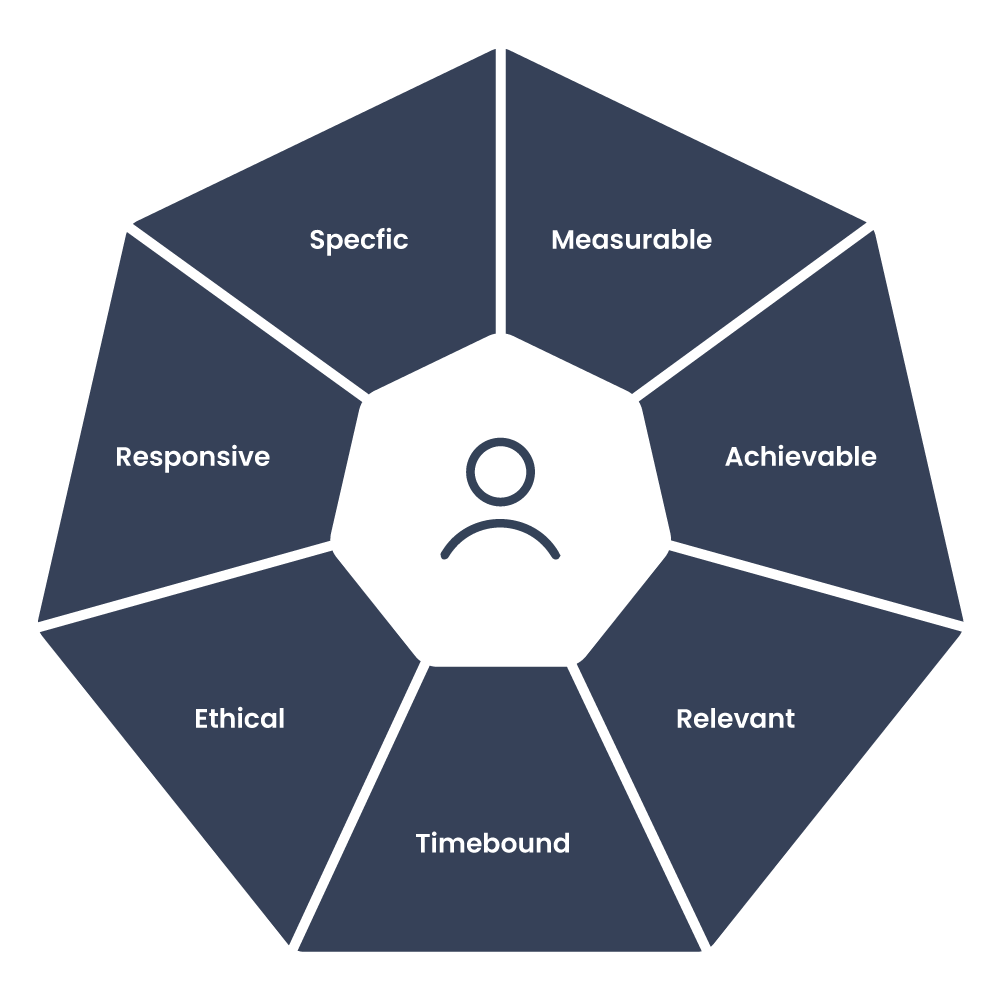
Fathom organises Goals through the SMARTER Goals Model - seven design criteria that govern how goals are created, evaluated, and adapted. This extends the established SMART framework (Locke and Latham's foundational research) with two additional criteria that address the ethical and adaptive demands of operating in an accelerating, uncertain world.
Specific: Clarity Eliminates Ambiguity
A goal must be clear and direct. Specificity answers the who, what, when, and where of your intended movement, ensuring there is no ambiguity about what you are trying to achieve. "Get healthier" is not a goal. "Run 5km three times per week for the next twelve weeks" is a goal. Specificity allows you to design corresponding Habits, identify the Pillar it belongs to, and define what success looks like.
The common failure is compound goals - objectives that contain multiple ambitions bundled together. Each goal should be expressible in a single sentence. If it requires a paragraph to explain, it is likely several goals disguised as one.
Measurable: What Gets Measured Gets Managed
A goal must have concrete criteria for success - quantified targets, defined milestones, or clear outcomes that allow honest assessment of progress. Measurability serves two functions: it tells you how far you have come, and it tells you when you have arrived.
Research on self-monitoring by Mark Muraven and colleagues, published in Psychological Bulletin, found that concrete, measurable goals produce significantly higher achievement rates than abstract aspirations. The common failure is subjective measures that invite self-deception - "feel more confident" is unmeasurable. "Deliver three presentations to groups of twenty or more by June" is measurable, and the confidence follows from the evidence.
Achievable: Ambitious but Grounded
A goal must challenge you while remaining within reach given your current Strengths. This is where Fathom's diagnostic approach transforms goal-setting: achievability is assessed not against motivation or willpower, but against structural reality. Do you have the Relevance (skills and knowledge), Reputation (credibility), Relationships (network support), and Resources (financial, temporal, energetic capacity) to pursue this goal?
A goal that requires Strengths you do not yet have is not wrong - but the first goal may need to be a Strength-building goal. Acquire the capability before pursuing the ambition. This is Fathom's core principle applied to goal-setting: diagnosis precedes prescription.
Relevant: Connected to What Actually Matters
A goal must align with your Values, strengthen your Pillars, and serve your broader direction. Relevance ensures your goal has a clear reason behind it - one that connects to your internal operating logic, not external expectations.
Research on self-concordance by Kennon Sheldon, published in Journal of Personality and Social Psychology, found that goals aligned with intrinsic values and genuine interests produce significantly higher sustained effort and satisfaction than goals pursued for external validation. The common failure is borrowed goals - ambitions inherited from peers, culture, or social media that look right from the outside but feel hollow from the inside.
Time-Bound: Deadlines Create Momentum
Every goal requires a defined timeframe that creates urgency and structures effort into manageable phases. Time-binding prevents goals from drifting into perpetual "someday" territory - the graveyard of good intentions.
Fathom recommends aligning goal deadlines with the system's quarterly review cycle. Goals with twelve-month timeframes should include quarterly milestones that allow honest progress assessment. Goals with shorter timeframes should include weekly checkpoints. The discipline is not in meeting every deadline perfectly - it is in reviewing honestly at each checkpoint and adapting based on evidence.
Ethical: Achievement Without Compromise
A goal must have a positive or neutral impact - not just on you, but on the people and systems around you. The Ethical criterion ensures your achievements align with your core Values (integrity, fairness, responsibility) and Principles, and that success does not come at the cost of integrity.
This extends goal-setting beyond personal optimisation into what philosophical traditions call ethical pragmatism - judging actions not only by their effectiveness but by their impact. A career goal pursued by undermining colleagues violates a fairness Principle. A wealth goal pursued by neglecting family violates a connection Principle. The Ethical criterion ensures goals produce achievements you can stand behind, not rationalise.
Responsive: Adaptable, Not Rigid
A goal must be flexible enough to adapt to changing circumstances. Responsiveness - rooted in the Stoic philosophical tradition of adjusting to what you cannot control - means building review points into every goal where direction, scope, timeline, or method can be honestly reassessed.
This is the criterion most conventional goal-setting frameworks lack entirely. In a world where Drivers fluctuate, Strengths shift, and external conditions change rapidly, rigid goals become liabilities. Research on goal disengagement and re-engagement by Carsten Wrosch, published in Personality and Social Psychology Bulletin, found that the ability to release unviable goals and redirect effort toward better-aligned alternatives predicted both psychological and physical health outcomes over time.
The common failure mode is confusing responsiveness with lack of commitment. Adapting a goal in light of genuine new information is strategic. Abandoning a goal at the first sign of difficulty is avoidance. Fathom's diagnostic layers - Drivers, Strengths, Pillars - provide the framework for distinguishing between the two.
Goals vs Habits: A Critical Distinction
In Fathom, Goals describe outcomes - where you are heading. Habits describe behaviour - what you are doing daily. Both sit in Execute Mode, but they serve fundamentally different functions and follow different rules.
Goals are reviewed. Habits are tracked. Goals are time-bound. Habits are ongoing. Goals are optional. Habits are decisive.
A goal without corresponding Habits is a wish - an aspiration with no execution mechanism. But a Habit without a specific Goal can still be valuable, because Habits compound regardless of whether a particular Goal justifies them. A daily learning habit does not need a certification goal to produce returns. A daily exercise habit does not need a race goal to build health.
This is why Fathom treats Goals as navigational and Habits as foundational. You can have a well-functioning system without goals. You cannot have one without habits.
How Goals Connect to the Rest of the System
Traits influence goal design. High Conscientiousness supports sustained goal pursuit through discipline. High Openness may generate too many goals simultaneously (possibility addiction). Low Neuroticism supports resilience through setbacks. Understanding your trait profile helps design goals that work with your wiring rather than against it.
Values determine whether a goal is genuinely yours. A goal disconnected from authentic values will feel like obligation and collapse under pressure. The Values assessment in Fathom's Explore Mode should precede any goal-setting - because goals without value alignment produce achievement without fulfilment.
Principles govern how a goal is pursued. A goal pursued through methods that violate Principles produces success that erodes integrity. If a goal cannot be achieved without violating your Principles, either the goal needs redesigning, the method needs changing, or the Principle needs honest re-examination.
Drivers have a particular relationship with goal-setting. The Pursuit Driver - the combination of Aspiration and Action - is directly served by Goals. Without Goals, Pursuit decays: aspiration has no target and action has no structure. But Goals also interact with the other three Drivers: goals set too far in the future can undermine Presence, goals achieved without a sense of Purpose produce emptiness, and goal failure without resilient Perspective triggers identity crisis.
Pillars prevent goal imbalance. If all your goals target the Work Pillar, the system makes that visible - before the neglected Wellbeing, Connection, or Recreation Pillars collapse. Fathom encourages goals across multiple Pillars, not just the one already receiving the most attention.
Strengths determine whether a goal is structurally viable. This is the most critical system connection: many goal failures are actually Strength failures. A goal to transition careers requires Relevance (transferable skills), Reputation (credibility in the new domain), Relationships (network access), and Resources (financial runway). Without the Strength check, the goal is set on unstable ground.
Habits are the execution mechanism for every goal. Each Goal must translate into at least one daily or weekly Habit. The Goal provides direction. The Habit provides evidence. Tasks turn a goal into this week's concrete next actions - the specific, completable work that moves it forward, drawn from your 168-hour budget and traceable back to the Goal it serves.
Common Goal Failure Modes
Understanding how goals fail is as important as designing them well. Fathom identifies seven recurring failure modes:
Identity fusion - defining yourself by your goals so that failure becomes existential rather than informational. This is the most dangerous pattern, because it makes honest evaluation impossible. If abandoning a goal means losing yourself, you will persist long past the point of reason.
Too many goals - scattering effort across too many directions simultaneously. Research on goal conflict by Robert Emmons, published in Journal of Personality and Social Psychology, found that pursuing multiple competing goals simultaneously reduces progress on all of them. Fathom recommends two to four active goals maximum, distributed across different Pillars.
Goals without Habits - setting ambitious targets with no daily execution system. The goal exists as an aspiration, but no corresponding Habits have been designed to provide the daily behavioural evidence of movement.
Goals without Strength checks - pursuing ambitions the structure cannot support. This produces predictable failure that is misdiagnosed as a motivation or discipline problem rather than a structural one.
Borrowed goals - pursuing what others expect rather than what genuinely matters. These goals fail not through lack of effort but through lack of meaning - the motivation that comes from genuine Value alignment is absent.
Rigid attachment - persisting with a goal long past the point where it stopped making sense. The Responsive criterion in the SMARTER model exists specifically to prevent this, but it requires the honest evaluation capacity that only comes from regular review.
Achievement collapse - reaching the goal, feeling empty, and immediately setting another without reflection. This pattern reveals that the goal was serving as a distraction from deeper questions - questions that Explore Mode (Traits, Values, Principles) is designed to address.
How to Set Your Goals: A Practical Guide
Step 1: Diagnose Before You Prescribe. Before setting any goal, complete Evaluate Mode. Assess your Drivers, Pillars, and Strengths. Where is energy concentrated? Where are the gaps? Which Strength is weakest? The goal you need may not be the goal you want - it may be a Strength-building goal that creates the structural conditions for your real ambition.
Step 2: Apply the SMARTER Criteria. Design each goal against all seven criteria: Specific, Measurable, Achievable, Relevant, Time-bound, Ethical, and Responsive. If a goal fails any criterion, redesign it before committing. Pay particular attention to Relevant (does it connect to genuine Values?) and Responsive (have you built in review points?).
Step 3: Translate Into Habits. Every goal must produce at least one corresponding Habit. If you cannot identify the daily or weekly action that moves you toward the goal, the goal is not yet actionable. The goal provides direction. The Habit provides the execution mechanism. Design the Habit using Fathom's LIFE Model for leverage, impact, flexibility, and evaluation.
Step 4: Anchor to Pillars. Check your goal distribution across the six Pillars. If all goals target a single domain (usually Work), consciously add at least one goal in a neglected Pillar. Goal balance prevents the imbalance pattern that produces achievement in one domain and collapse in others.
Step 5: Review Quarterly. Every ninety days, review each active goal against the SMARTER criteria. Is it still Relevant? Is it still Achievable given current Strengths? Does it still align with your Values? Has anything changed that requires adaptation? Retiring a goal that no longer serves you is not failure - it is the Responsive criterion in action.
Start Setting SMARTER Goals
The Goals framework is one component of Fathom's integrated personal development system - a structured approach to self-understanding, intentional living, and behavioural evidence for executives and professionals navigating complexity. Goals provide direction. They prevent stagnation. But they do not define you. Explore how Fathom works or get started today.
FAQ
Frequently Asked Questions
Why are goals optional in Fathom?
Because Habits compound regardless of whether a specific goal justifies them, and because identity fusion with goals is one of the most common causes of psychological distress in high-achieving professionals. Goals prevent stagnation and provide direction, but they are instruments - not the system itself. You can run Fathom effectively with no active goals, as long as your Habits are strategically designed and your Tasks stay traceable to what matters. Goals add direction. They are not required for the system to function.
How is SMARTER different from regular SMART goals?
The SMART framework (Specific, Measurable, Achievable, Relevant, Time-bound) was developed from Locke and Latham's goal-setting research and remains foundational. Fathom extends it with two additional criteria: Ethical (ensuring goals align with your core Values and Principles, and that achievement does not compromise integrity) and Responsive (ensuring goals can adapt to changing circumstances rather than becoming rigid liabilities). These additions reflect the reality that goal-setting in an accelerating, uncertain world requires both moral clarity and structural flexibility.
How many goals should I have at once?
Fathom recommends two to four active goals distributed across different Pillars. This is enough to maintain direction across multiple life domains without creating goal conflict that reduces progress on all fronts. If you have more than four active goals, you likely need to prioritise - which itself requires the diagnostic clarity that Evaluate Mode provides.
What happens when a goal fails?
Goal failure in Fathom is treated as diagnostic information, not character assessment. It typically indicates one of several system-level issues: weak Strengths that could not support the pursuit, misaligned Values that produced insufficient motivation, absent Habits that left the goal without an execution mechanism, or changing circumstances that made the goal unviable. The response is diagnosis, not self-criticism. Identify what the failure is signalling, address the underlying issue, and redesign or retire the goal accordingly.
How do goals relate to habits and tasks?
Goals, Habits, and Tasks form the Execute triad in Fathom. Goals provide direction (where you are heading). Habits provide consistency (what you do repeatedly, on purpose). Tasks provide today (the concrete, completable work due now). Goals are reviewed periodically; Habits are tracked daily; Tasks are completed and cleared. Together, they provide the complete execution picture - direction, consistency, and today's work.
About The Author
Dan Ford, Executive Career Coach & Founder of Fathom
Dan Ford is an executive career coach and the creator of Fathom - a personal development system for executives and professionals navigating complexity, career uncertainty, and rapid technological change. Drawing on goal-setting theory, organisational psychology, and a decade of experience coaching professionals through high-stakes transitions, Fathom provides the structured self-examination that generic apps and expensive coaching alternatives cannot.
About FathomThe Framework
Explore the Full System
Explore
Values
“What actually matters?”
The enduring priorities that determine what feels meaningful, what motivates effort, and how fulfilment is evaluated.
Read more
Traits
“How am I wired?”
Stable personality tendencies that influence energy, sensitivity, friction, and behavioural defaults. Based on the Five-Factor Model.
Read more
Principles
“How do I choose to act?”
Explicit decision rules that govern behaviour when values conflict, pressure is high, or clarity is missing.
Read more
Evaluate
Pillars
“Where is life happening?”
Six domains - Work, Wellbeing, Wealth, Recreation, Connection, Environment - that reveal allocation of energy and domain imbalance.
Read more
Drivers
“How is life actually being lived?”
Four dynamic conditions - Presence, Purpose, Perspective, Pursuit - that rise and fall depending on attention, choices, and circumstances.
Read more
Strengths
“Is growth structurally possible?”
Four structural enablers - Relevance, Reputation, Relationships, Resources - that determine whether effort is viable.
Read more
Execute
Goals
“Where am I heading?”
Direction, not identity. Goals clarify intended movement. They are optional within the system - they prevent stagnation, but they do not define you.
You Are Here
Habits
“What am I doing, repeatedly, on purpose?”
Observable, repeatable, trackable actions. Strategic daily investments that compound over time to shape identity and outcomes.
Read more
Tasks
“What am I doing about it today?”
The atomic unit of Execute. Concrete, completable actions that turn each week’s 168 hours into visible daily progress.
Read more
Stop Drifting. Start Building.
Fathom is a personal development system for professionals who take their future seriously. One system. Full access to everything.
Where Are You in the Transition?
14-day cooling-off period. Cancel anytime. No tiers. No upsells.