
Execute
Building Strategic Habits: The Only Place Where Change Actually Happens
Habits are observable, repeatable actions that translate meaning, structure, and choice into lived reality. In Fathom's personal development system, Habits are treated as strategic daily investments - small, consistent actions that compound over time to shape identity, outcomes, and life direction. They are the only place in the system where change actually happens.
Most personal development systems fail at the same point: insight is gained, clarity improves, motivation rises - and nothing changes. This happens because execution is vague, behaviour is untracked, and action is disconnected from strategy. The global habit-tracking app market has grown to over $5 billion, yet research published in the European Journal of Social Psychology by Phillippa Lally and colleagues found that only 36% of people who set intentional behaviour goals successfully form lasting habits - a failure rate that has remained stubbornly consistent despite the proliferation of tracking tools. The problem is not willpower. The problem is that most habit systems are disconnected from the deeper architecture of identity, values, and life structure.
Fathom solves this by treating Habits as the execution layer of an integrated system. Within the Fathom personal development system, Habits sit in Execute Mode alongside Goals and Tasks - the three components where intention meets reality. Traits influence ease and resistance. Values define what matters. Principles define decision rules. Drivers describe how life is being experienced. Strengths define structural capacity. Pillars define life domains. Goals provide direction. Habits and Tasks are where all of this is tested - the behavioural evidence layer where everything above either shows up in daily action or does not exist.
By Dan Ford · August 2026
The Article
Habits
What Makes a Habit a Habit in Fathom?
Not every repeated action qualifies as a Habit in Fathom. The system applies five criteria that distinguish strategic habits from autopilot routines or wishful thinking:
Behavioural - it must be something you can observe or track. "Be more mindful" is not a habit. "Meditate for ten minutes each morning" is. The distinction is critical: if you cannot answer "Did I do this today?" with a clear yes or no, it is not a habit. It is an intention.
Repeatable - it must be capable of being done regularly. One-time actions, however valuable, are tasks, not habits. Habits derive their power from repetition and compounding - research by Wendy Wood at the University of Southern California, published in Annual Review of Psychology, found that approximately 43% of daily actions are performed habitually, suggesting that the most effective route to long-term change is through the behaviours you repeat, not the decisions you make.
Intentional - it must be chosen, not accidental. Fathom distinguishes between deliberate habits (chosen to express Values and Principles) and default habits (patterns that formed without conscious decision). Many people are executing habits they never chose - and wondering why progress feels disconnected from intention.
Contextualised - it must be anchored to a Pillar and aligned with Principles. A habit without context is a floating action. A habit anchored to the Wellbeing Pillar and governed by a Presence Principle becomes a strategic investment in a specific life domain. This anchoring is what prevents the "productive imbalance" trap - tracking many habits while unknowingly concentrating all effort in a single area.
Trackable - it must be verifiable over time. If it cannot be tracked, it is not a Habit in Fathom. This is a deliberate design choice: Fathom's core rule is that behaviour is what gets measured - the Habits you repeat and the Tasks you complete. Everything else in the system diagnoses, evaluates, or governs. Behaviour is where truth is revealed.
The LIFE Model: How Fathom Organises Habit Execution
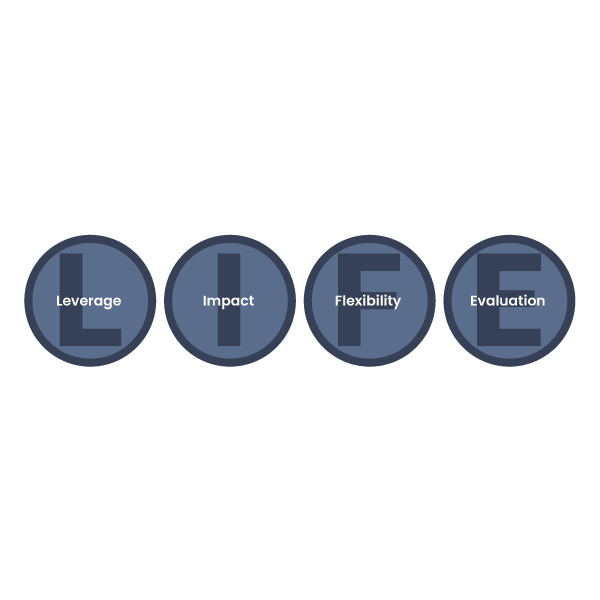
Fathom organises Habits through the LIFE Model - four execution dynamics that govern how habits are chosen, executed, and reviewed. This is not a mindset model. It is an execution system.
Leverage: Small Actions, Disproportionate Effect
Leverage refers to the intentional use of micro-investments - small actions that create outsized returns over time. Rather than focusing on intensity or scale, Fathom prioritises consistency, strategic placement, and compounding effect.
Research on habit stacking by James Clear, drawing on B.J. Fogg's Tiny Habits research at Stanford, has demonstrated that small, consistently placed actions produce more durable behaviour change than ambitious efforts that collapse under real-world friction. A ten-minute daily learning habit maintained for a year produces 60 hours of skill development - not through dramatic effort, but through leverage.
The common failure mode is overloading: designing twelve habits, maintaining them for two weeks, and abandoning all of them. Fathom recommends fewer, higher-leverage habits - typically five to eight active habits distributed across Pillars - rather than an exhaustive list that collapses under its own weight.
Impact: Choosing the Right Actions
Impact is about directing habits toward actions that meaningfully advance your Values, Principles, Drivers, and Pillars. Not all habits are equal. Some merely maintain. Others change trajectory.
High-impact habits are those that remove bottlenecks, influence multiple Pillars simultaneously, or address the weakest Driver or Strength. A daily exercise habit simultaneously strengthens the Wellbeing Pillar, improves the Presence Driver through stress reduction, and protects the Resources Strength through long-term health maintenance - a single action with triple impact.
The common failure mode is mistaking activity for progress: tracking habits that feel productive but change nothing. Fathom's system connections help identify which habits produce genuine impact by mapping them to the diagnostic layers above.
Flexibility: Adapting Without Abandoning
Flexibility recognises that life changes, capacity fluctuates, and seasons shift. Habits must evolve without collapsing. This is one of the most neglected dimensions in habit formation - and one of the primary reasons habits fail.
Research on habit disruption by Bas Verplanken, published in the British Journal of Health Psychology, found that life transitions (job changes, relocations, relationship shifts) are both the most common points of habit failure and the most powerful opportunities for habit formation. Fathom addresses this by building adaptation into the system: adjusting frequency rather than abandoning habits, scaling actions up or down as Strengths and Drivers change, and modifying habits as circumstances evolve.
The common failure mode is rigid perfectionism - "all-or-nothing" thinking that treats a missed day as total failure. Fathom's tracking is designed to record consistency patterns, not enforce perfection.
Evaluation: Feedback, Not Self-Judgement
Evaluation is the regular review of whether habits are being executed, whether they are still relevant, and whether they are producing the intended effect. Evaluation is diagnostic, not moral.
Effective evaluation reviews habits against Principles, identifies friction and resistance patterns, and adjusts based on evidence rather than emotion. Research on self-monitoring by Mark Muraven and Roy Baumeister, published in Psychological Bulletin, found that reflective monitoring - reviewing behaviour patterns rather than simply counting completions - produces significantly better long-term behaviour change than passive tracking alone.
The common failure mode is tracking without reflection: logging habits daily but never asking whether those habits are still the right ones. Fathom's evaluation cycle encourages quarterly habit audits - reviewing not just compliance but alignment and impact.
Habits vs Goals: A Critical Distinction
In Fathom, Goals describe outcomes. Habits describe behaviour. Both sit in Execute Mode, but they serve fundamentally different functions. You do not achieve habits. You live them. This distinction matters because goals create a finish line - and finish lines create the conditions for post-achievement collapse. A person who achieves a fitness goal and then stops exercising has demonstrated that the goal was the motivator, not the behaviour. When the goal disappears, so does the action.
Habits, by contrast, compound. They do not require a destination to maintain their value. A daily learning habit does not need a specific certification goal to justify itself - it compounds into an expanding skill base that strengthens Relevance regardless of any particular outcome.
In Fathom, Goals are optional - they provide direction and prevent stagnation, but they do not define you. Habits are decisive - they provide the daily evidence that your Values and Principles are being lived, not merely declared. Goals clarify where you are heading. Habits prove you are actually moving.
How Habits Connect to Every Pillar
Every Habit in Fathom must live inside a Pillar context. This structural requirement prevents the most common habit imbalance: concentrating all tracked habits in one domain (usually Work) while other areas silently deteriorate.
Work habits might include daily deep work blocks, weekly strategic review, or deliberate skill development. Wellbeing habits might include exercise, sleep hygiene, or stress recovery practices. Wealth habits might include financial review, savings automation, or investment research. Recreation habits might include protected leisure time, creative outlets, or deliberate play. Connection habits might include regular relationship maintenance, scheduled social time, or communication practices. Environment habits might include digital boundary-setting, workspace optimisation, or physical decluttering.
The Pillar-anchoring system reveals where life energy is actually going. If all your habits are Work habits, the system makes that imbalance visible - before burnout makes it undeniable.
Common Habit Failure Modes
Understanding how habits fail is as important as designing them well. Fathom identifies five recurring failure modes:
Too many habits. Enthusiasm creates overload. The system cannot sustain fifteen tracked habits, and the attempt to maintain them produces guilt and abandonment rather than progress. Fathom recommends starting with five to eight and adding gradually.
Habits disconnected from values. A habit that does not connect to a genuine Value will feel like obligation rather than investment. If a habit consistently feels like a chore, the problem may not be discipline - it may be misalignment. The habit needs to be redesigned or replaced.
Tracking without reflection. Logging completions without reviewing patterns produces data without insight. The habit tracker becomes a checkbox, not a diagnostic tool. Fathom's evaluation dynamic exists specifically to prevent this.
Optimising habits while Strengths are weak. Designing ambitious habits when Resources are depleted, Relationships are strained, or Relevance is eroding is building on unstable ground. Fathom insists on structural diagnosis before habit design - because many habit failures are actually Strength failures in disguise.
Using habits to compensate for avoidance elsewhere. Compulsive productivity habits can mask avoidance of difficult emotional or relational work. The person who tracks twelve Work habits but zero Connection habits is using execution as escape. This is where honest habit evaluation matters most - distinguishing the deliberate habits that express your Values from the default ones that quietly help you avoid harder work.
How Habits Connect to the Rest of the System
Traits influence habit design. A highly conscientious person can build habits through discipline alone. A person lower in Conscientiousness needs environmental scaffolding, accountability structures, and lower-friction designs. Trait-informed habit design produces habits that work with your wiring.
Values provide the motivation layer. Habits aligned with genuine values feel like investments. Habits disconnected from values feel like chores. When a habit consistently produces resistance, checking value alignment is the first diagnostic step.
Principles govern when a habit is kept, modified, or dropped. If a habit repeatedly violates a Principle, either the habit is wrong or the Principle is unclear. Habits are how Principles are stress-tested in daily life.
Drivers are strengthened or weakened by habit patterns. Presence is built through mindfulness and recovery habits. Pursuit is built through execution and completion habits. Weak Drivers often indicate missing habits rather than missing motivation.
Tasks are the other half of execution. Where Habits are the behaviours you repeat on purpose, Tasks are the specific, completable work of today - the concrete actions that move a Goal forward this week. Together, Habits and Tasks are the behavioural layer the rest of the system is tested against.
How to Build Your Habits: A Practical Guide
Step 1: Start With Your Pillar Map. Before designing habits, assess your current Pillar balance. Where is energy concentrated? Where are the gaps? Your first habits should address the most neglected Pillar, not reinforce the one that already receives the most attention.
Step 2: Choose for Leverage and Impact. Select habits that are small enough to sustain daily and impactful enough to create genuine change. The ideal habit takes five to thirty minutes, can be performed consistently, and connects to a Value, a Principle, and a Pillar simultaneously.
Step 3: Anchor to Principles. Each habit should connect to at least one Principle. This creates a chain of meaning: the Value explains why it matters, the Principle governs how you engage with it, and the Habit provides the daily evidence that both are being lived.
Step 4: Track Honestly. Use Fathom's habit tracker to record completions daily. The goal is not perfection - it is truth. A week of honest data showing 40% completion is more valuable than a week of inflated tracking showing 100%. Honest tracking enables honest evaluation.
Step 5: Evaluate Quarterly. Review your habit set every ninety days. Which habits are producing impact? Which have become automatic and no longer need tracking? Which should be replaced? Fathom's LIFE Model evaluation dynamic provides the framework for this review - assessing not just whether habits were completed, but whether they remain the right habits for where you are now.
Start Building Your Habits
The Habits framework is one component of Fathom's integrated personal development system - a structured approach to self-understanding, intentional living, and behavioural evidence for executives and professionals navigating complexity. Habits are the only place where change actually happens. Everything else is preparation. Explore how Fathom works or get started today.
FAQ
Frequently Asked Questions
How many habits should I track?
Fathom recommends five to eight active habits distributed across multiple Pillars. This is enough to maintain coverage across life domains without creating unsustainable overload. If you cannot maintain your current habits for three consecutive weeks, you have too many. Start small, build consistency, and add gradually.
What is the difference between habits and goals?
Goals describe outcomes you are working toward - they are future-directed and time-bound. Habits describe behaviours you perform repeatedly - they are present-focused and ongoing. In Fathom, Goals are optional. Habits are decisive. A goal provides direction, but a habit provides the daily evidence that you are actually moving. Goals have finish lines. Habits compound.
How do habits relate to tasks in Fathom?
Habits and Tasks are the two sides of execution in Fathom. Habits are the behaviours you repeat on purpose - tracked daily, valuable through consistency. Tasks are the specific, completable work of today - done once and cleared. Habits build the pattern; Tasks handle the particular. A person with strong daily Work habits and a clear, traceable set of weekly Tasks can see both what they are building and what they are actually getting done.
What if I keep failing at a habit?
Repeated habit failure is a diagnostic signal, not a discipline problem. It typically indicates one of four issues: the habit is too ambitious (reduce scope), it is disconnected from your Values (redesign it), your Strengths are too weak to support it (address the structural issue first), or it conflicts with your Trait profile (redesign it to work with your wiring). Fathom treats habit failure the same way it treats all system signals - as information that points to where attention is needed.
Why does Fathom focus on behaviour, not just intention?
This is a deliberate design choice. Everything else in the Fathom system - Traits, Values, Principles, Drivers, Pillars, Strengths - exists to diagnose, evaluate, or govern. Only your Habits and Tasks represent actual behaviour - what you repeat and what you complete. By measuring behaviour, Fathom reflects reality rather than intention. This is the core principle: behaviour matters more than aspiration.
About The Author
Dan Ford, Executive Career Coach & Founder of Fathom
Dan Ford is an executive career coach and the creator of Fathom - a personal development system for executives and professionals navigating complexity, career uncertainty, and rapid technological change. Drawing on modern behavioural psychology, habit formation research, and a decade of experience coaching professionals through high-stakes transitions, Fathom provides the structured self-examination that generic apps and expensive coaching alternatives cannot.
About FathomThe Framework
Explore the Full System
Explore
Values
“What actually matters?”
The enduring priorities that determine what feels meaningful, what motivates effort, and how fulfilment is evaluated.
Read more
Traits
“How am I wired?”
Stable personality tendencies that influence energy, sensitivity, friction, and behavioural defaults. Based on the Five-Factor Model.
Read more
Principles
“How do I choose to act?”
Explicit decision rules that govern behaviour when values conflict, pressure is high, or clarity is missing.
Read more
Evaluate
Pillars
“Where is life happening?”
Six domains - Work, Wellbeing, Wealth, Recreation, Connection, Environment - that reveal allocation of energy and domain imbalance.
Read more
Drivers
“How is life actually being lived?”
Four dynamic conditions - Presence, Purpose, Perspective, Pursuit - that rise and fall depending on attention, choices, and circumstances.
Read more
Strengths
“Is growth structurally possible?”
Four structural enablers - Relevance, Reputation, Relationships, Resources - that determine whether effort is viable.
Read more
Execute
Goals
“Where am I heading?”
Direction, not identity. Goals clarify intended movement. They are optional within the system - they prevent stagnation, but they do not define you.
Read more
Habits
“What am I doing, repeatedly, on purpose?”
Observable, repeatable, trackable actions. Strategic daily investments that compound over time to shape identity and outcomes.
You Are Here
Tasks
“What am I doing about it today?”
The atomic unit of Execute. Concrete, completable actions that turn each week’s 168 hours into visible daily progress.
Read more
Stop Drifting. Start Building.
Fathom is a personal development system for professionals who take their future seriously. One system. Full access to everything.
Where Are You in the Transition?
14-day cooling-off period. Cancel anytime. No tiers. No upsells.