
Evaluate
The Six Pillars Model: Mapping Where Life Is Actually Happening
The Six Pillars - Work, Wellbeing, Wealth, Recreation, Connection, and Environment - are the primary life domains through which human experience, effort, and identity are expressed. Developed as part of Fathom's personal development system, the Pillars model makes life allocation visible by revealing where energy is concentrated, where neglect is accumulating, and where trade-offs are being made unconsciously.
Unlike Drivers (which diagnose how life is being experienced) or Strengths (which assess whether growth is structurally possible), Pillars describe where life is actually happening. They are domain-level containers - the arenas in which choices are made, energy is spent, and balance or imbalance becomes visible. Most people experience imbalance not because they lack motivation or insight, but because effort is concentrated in too few domains and neglect accumulates invisibly in the others.
The Pillars model draws on several well-established traditions: Maslow's hierarchy of needs, positive psychology research demonstrating that wellbeing is multi-dimensional, Aristotelian ethics on balance and moderation, and Eastern philosophical traditions including Taoism. A 2020 meta-analysis published in Psychological Bulletin found that individuals who maintained engagement across multiple life domains reported significantly higher wellbeing than those who over-invested in a single domain, even when that single domain was performing well.
Within the Fathom personal development system, Pillars sit in Evaluate Mode alongside Drivers and Strengths. Drivers describe how you are engaging with life. Pillars describe where that engagement is taking place. Habits describe what you do repeatedly within each Pillar. A professional who feels burned out (a Driver problem) may not need more resilience - they may need to redirect energy from an over-invested Work Pillar toward neglected Wellbeing or Recreation.
By Dan Ford · August 2026
The Article
Pillars
What Are the Six Pillars?
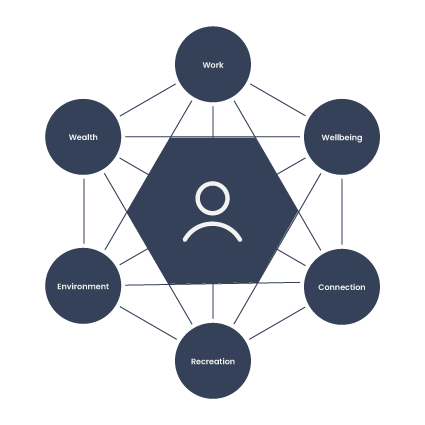
The Six Pillars are Work, Wellbeing, Wealth, Recreation, Connection, and Environment. Each Pillar represents a distinct but interdependent domain of life. Together, they provide a complete map of where your time, energy, and attention are being allocated - and where gaps exist.
Think of Pillars as a diagnostic map, not a moral scorecard. They do not tell you what your life should look like. They reveal what your life does look like, so you can make conscious adjustments rather than drifting into imbalance. A fulfilled life does not require perfection in every Pillar - but it does require conscious attention to all six over time.
Importantly, Pillars are not Values (what matters to you), not goals (what you are aiming for), and not Strengths (whether growth is structurally possible). They are contexts - the domains in which everything else plays out.
The six Pillars and their core functions are:
- Work - purpose, contribution, and craft
- Wellbeing - physical, mental, emotional, and inner health
- Wealth - security, freedom, and optionality
- Recreation - rest, play, and renewal
- Connection - belonging, intimacy, and social bond
- Environment - the context that shapes behaviour
Pillar 1: Work - Purpose, Contribution, and Craft
Work is the domain through which effort, skill, and responsibility are translated into contribution and value. It is not limited to employment - it includes career, vocation, enterprise, and any form of meaningful output. In the Fathom system, the Work Pillar captures the quality and alignment of your productive engagement with the world.
Research on job satisfaction and meaningful work consistently demonstrates that alignment between effort and values is more predictive of sustained engagement than compensation alone. A 2022 Gallup workplace study found that employees who reported a strong sense of purpose in their work were 3.5 times more likely to be engaged and significantly less likely to experience burnout - regardless of role, seniority, or industry.
A healthy Work Pillar shows up as alignment between effort and values, a sense of contribution and progress, and ongoing learning and Relevance. An unhealthy Work Pillar shows up as disengagement or burnout, identity over-attachment to a role (where losing the job means losing yourself), and stagnation or loss of meaning.
The key tension within Work is achievement versus sustainability. Many executives and professionals have optimised relentlessly for achievement while neglecting whether their pace is sustainable. This is one of the most common patterns Fathom identifies - a strong Work Pillar that is quietly eroding the Wellbeing Pillar underneath it.
In the context of career resilience in the AI age, the Work Pillar becomes especially important. AI-driven disruption does not just threaten jobs - it threatens the sense of contribution and craft that makes work meaningful.
Pillar 2: Wellbeing - Physical, Mental, Emotional, and Inner Health
Wellbeing is the domain of health, regulation, and internal stability. It underpins every other Pillar - without sufficient energy, emotional regulation, and mental clarity, performance in every other domain degrades. Wellbeing is the foundation on which the entire system rests.
The relationship between wellbeing and performance is well-documented. Research by the American Psychological Association has consistently shown that chronic stress reduces cognitive function by up to 25%, directly impairing decision-making quality. A 2021 study published in The Lancet found that individuals who maintained consistent physical activity, adequate sleep, and emotional regulation practices reported substantially higher resilience during periods of disruption.
A healthy Wellbeing Pillar shows up as sufficient energy and recovery, emotional regulation, and mental clarity and resilience. An unhealthy Wellbeing Pillar shows up as chronic stress or fatigue, neglect of physical health, and emotional volatility that spills into other domains.
The key tension within Wellbeing is performance versus preservation. High-performing professionals often treat their health as a resource to be spent rather than an asset to be maintained. The irony is brutal: the very professionals who most need sustained cognitive performance are the ones most likely to undermine it through neglect of this Pillar.
Wellbeing connects directly to the Presence Driver. Chronic stress and fatigue pull attention into anxious rumination, making genuine present-moment engagement impossible. Strengthening the Wellbeing Pillar often produces immediate improvements in Presence without any explicit mindfulness practice.
Pillar 3: Wealth - Security, Freedom, and Optionality
Wealth is the domain of financial stability, independence, and long-term security. It is not about accumulation alone - it is about choice. In the Fathom system, Wealth is measured not by how much you earn but by how much freedom and optionality your financial position provides.
Research on financial wellbeing reinforces this distinction. Daniel Kahneman and Angus Deaton's landmark 2010 study found that emotional wellbeing increases with income only up to a threshold - beyond which additional income produces diminishing returns on day-to-day experience. More recent research by Matthew Killingsworth, published in PNAS in 2023, found a more nuanced relationship - suggesting that for most people, income continues to affect experienced wellbeing beyond the earlier threshold, particularly when it enables greater control over time.
A healthy Wealth Pillar shows up as financial clarity, reduced anxiety around money, and the ability to plan and invest in future directions. An unhealthy Wealth Pillar shows up as constant financial pressure, avoidance or denial around money, and over-identification with money as status rather than as a tool for freedom.
The key tension within Wealth is consumption versus optionality. Every pound spent on consumption is a pound unavailable for optionality. For Fathom's target audience - executives and professionals navigating uncertainty - the optionality that comes from financial margin may be more valuable than the lifestyle that comes from spending it.
Wealth connects directly to the Resources Strength. Where the Resources Strength assesses your total capacity to act (financial, temporal, cognitive), the Wealth Pillar focuses specifically on the financial dimension and its emotional weight. You can have adequate Resources overall but an unhealthy relationship with Wealth - or strong financial Resources but poor allocation across the other Pillars.
Pillar 4: Recreation - Rest, Play, and Renewal
Recreation is the domain of enjoyment, play, creativity, and non-instrumental activity. It exists for renewal, not productivity. In a culture that celebrates relentless optimisation, Recreation is the Pillar most commonly neglected - and its absence is the silent accelerant behind most burnout.
Stuart Brown's research on play, published in his book Play: How It Shapes the Brain, Opens the Imagination, and Invigorates the Soul, demonstrated that play is not a luxury or a reward for completed work. It is a biological necessity that supports creativity, emotional regulation, and cognitive flexibility. Adults who maintain regular play and recreation show measurably higher adaptability and problem-solving capability than those who do not.
A healthy Recreation Pillar shows up as regular enjoyment, creative or physical outlets, and perspective beyond work and responsibility. An unhealthy Recreation Pillar shows up as guilt around rest, compulsive distraction (scrolling, bingeing - activity that numbs rather than renews), and the absence of genuine joy or play.
The key tension within Recreation is restorative recreation versus escapism. Not all downtime is equal. Scrolling social media for two hours and spending two hours painting produce radically different effects on recovery. Fathom distinguishes between recreation that restores (active engagement, creativity, movement, genuine enjoyment) and escapism that merely numbs (compulsive consumption, passive distraction). The latter is usually a default habit worth naming honestly rather than genuine Recreation.
Recreation connects to the Presence Driver - genuine play requires full present-moment engagement, making it one of the most natural pathways to strengthening Presence without formal contemplative practice.
Pillar 6: Environment - The Context That Shapes Behaviour
Environment is the physical and digital context in which life is lived. It silently shapes behaviour, energy, and attention - often more powerfully than intention or willpower. Environment is the Pillar that operates in the background, influencing every other domain without being noticed until something changes.
Research on environmental design and behaviour consistently demonstrates that context is a stronger predictor of behaviour than motivation. James Clear, drawing on B.J. Fogg's behavioural research at Stanford, has shown that designing environments to support desired behaviours is more effective than relying on discipline alone. Workspace design significantly affects cognitive performance, emotional wellbeing, and interpersonal behaviour - with well-designed environments producing measurable improvements across all three.
A healthy Environment Pillar shows up as spaces that support focus and rest, alignment between surroundings and values, and intentional digital and physical design. An unhealthy Environment Pillar shows up as clutter and friction, overstimulation, and environments that undermine wellbeing or work despite best intentions.
The key tension within Environment is convenience versus intentional design. Default environments - the home you happened to rent, the desk setup you inherited, the notification settings your phone came with - are almost never optimised for the life you are trying to build. Environmental Habits (regular decluttering, digital boundary-setting, workspace optimisation) are among the highest-leverage habits in the system because they change the context in which all other habits operate.
How the Pillars Interact: Common Imbalances
The Pillars are interdependent - strength or neglect in one domain ripples through the others. Work pressure erodes Wellbeing. Wealth stress undermines Connection. Poor Environment degrades every Pillar simultaneously. Neglected Recreation reduces performance everywhere.
Understanding the common imbalance patterns helps identify where intervention is most needed:
Strong Work, weak Recreation is the classic burnout pattern. Professional output is high, but there is no renewal. Performance feels sustainable until it suddenly is not. This pattern is especially common among executives and professionals who have spent years optimising for achievement without protecting recovery.
Strong Wealth, weak Connection produces emptiness. Financial security is in place, but relationships have been neglected in pursuit of it. This pattern often surfaces after a major career milestone - the promotion arrives, but there is no one to celebrate with who truly knows you.
Strong Wellbeing, weak Work produces stagnation. Physical and mental health are maintained, but professional engagement has drifted. Life feels comfortable but lacks direction and contribution.
Strong Environment, weak internal Drivers produces aesthetic order without fulfilment. The space is beautiful, the systems are pristine, but the person inside them is disconnected from meaning or direction. This is environment as avoidance - perfecting the container while neglecting the contents.
Balance does not mean equal time across all six Pillars. It means conscious allocation - understanding where your energy is going, making deliberate trade-offs, and preventing any single Pillar from silently collapsing.
How Pillars Connect to the Rest of the System
Pillars interact with every other component in the Fathom framework:
Traits influence which Pillars come naturally and which require deliberate effort. High Conscientiousness supports a strong Work Pillar. High Agreeableness may strengthen Connection but create difficulty setting boundaries in Work. Understanding your trait profile prevents designing a Pillar balance that fights your wiring.
Values determine which Pillars feel most meaningful. Someone who values achievement will naturally invest in Work. Someone who values security will prioritise Wealth. Values explain why two people with identical circumstances may have entirely different Pillar profiles - and why both can be valid.
Drivers operate across Pillars. Low Presence can manifest in any Pillar - inability to enjoy a meal (Wellbeing), inability to focus at work (Work), inability to engage during a conversation (Connection). Diagnosing which Pillar the Driver imbalance is most affecting helps target the intervention.
Strengths operate beneath Pillars. Your Work Pillar depends on the Relevance and Reputation Strengths. Your Wealth Pillar depends on the Resources Strength. Your Connection Pillar intersects with the Relationships Strength - though they measure different dimensions. Weak Strengths erode the Pillars above them.
Habits must be anchored to Pillars. Every habit in Fathom lives inside a Pillar context - Work habits, Wellbeing habits, Wealth habits, Recreation habits, Connection habits, Environment habits. This prevents over-investment in one domain and reveals where life energy is actually going. If all your habits are Work habits, the Pillar map makes that imbalance visible.
Tasks allocate your hours across Pillars. Because every Project groups tasks under a Pillar and the week's 168 hours are budgeted across them, your task surface shows - with receipts - which Pillars are actually receiving your time and which are being quietly starved. A Pillar you claim matters but never allocate hours to is not being balanced; it is being abandoned.
How to Use the Pillars Model: A Practical Guide
Applying the Pillars model requires honest assessment of where your energy and attention are actually going - not where you think they should be. Here is a five-step process:
Step 1: Map Your Current Allocation. Rate each of the six Pillars on a simple scale. Where is your time and energy concentrated? Which Pillars are thriving? Which are neglected? Fathom's built-in assessment tools guide this process, but even a weekly self-reflection is valuable. The key question is not "How do I feel about each area?" but "Where is my energy actually going?"
Step 2: Identify the Neglected Pillar. Look for the domain that has been quietly declining while other Pillars received attention. Neglect accumulates silently - the Pillar that feels "fine" because you have not thought about it is often the one most in need of attention.
Step 3: Examine the Trade-Offs. Every Pillar imbalance involves a trade-off, usually made unconsciously. If Work is strong and Recreation is weak, you traded renewal for output. If Wealth is strong and Connection is weak, you traded relational investment for financial security. Making these trade-offs conscious is the first step toward recalibration.
Step 4: Place Habits in Pillar Context. Once you have identified the neglected Pillar, design specific Habits that address it. A Recreation habit (weekly creative activity), a Connection habit (regular meaningful contact), a Wellbeing habit (protected recovery time). Anchor each habit to its Pillar and assign a supporting Principle - for example, I protect renewal with the same discipline I bring to work.
Step 5: Reassess Monthly. Pillar balance shifts with circumstances - a new project overloads Work, a health event demands attention to Wellbeing, a move disrupts Environment. Fathom recommends monthly Pillar assessment to catch imbalance before it accumulates into crisis. The Fathom app provides structured tools to make this consistent and trackable.
The goal is not symmetry. The goal is conscious allocation - knowing where your life energy is going and choosing that distribution deliberately rather than defaulting into it.
Start Mapping Your Pillars
The Pillars model is one component of Fathom's integrated personal development system - a structured approach to self-understanding, intentional living, and behavioural evidence for executives and professionals navigating complexity. Neglect accumulates silently. Balance requires awareness, not perfection. The first step is making your current allocation visible. Explore how Fathom works or get started today.
FAQ
Frequently Asked Questions
What is the difference between Pillars and Drivers?
Drivers (Presence, Purpose, Perspective, Pursuit) describe dynamic experiential states - how life feels and how you are engaging with it. Pillars describe the domains where that engagement takes place. You might have strong Presence (a Driver) but only within your Work Pillar - meaning you are fully engaged at work but emotionally absent everywhere else. Drivers tell you how you are living. Pillars tell you where you are living. Both are assessed in Fathom's Evaluate Mode, and they illuminate different dimensions of the same reality.
Why does Fathom use "Connection" instead of "Relationships"?
Fathom deliberately separates experiential connection from structural relationships. Connection (Pillar) measures the lived quality of human bond - belonging, intimacy, mutual understanding. Relationships (Strength) measures the structural access your professional network provides - depth, breadth, and strategic alignment. You can have extensive professional relationships without feeling genuinely connected, or deep personal connection with minimal professional network. Both dimensions matter, and diagnosing them separately produces more accurate interventions.
How is the Environment Pillar different from the others?
Environment is unique because it operates as a context that influences every other Pillar rather than being a domain of direct engagement. Your physical and digital environment shapes your capacity for work, your wellbeing, your financial behaviour, your recreation quality, and your connection with others. This makes Environment one of the highest-leverage Pillars - small environmental changes can produce improvements across multiple domains simultaneously.
Can you have too many strong Pillars?
Strength across all Pillars is the ideal, but in practice, the more important question is whether apparent strength in one Pillar is coming at the hidden cost of another. A professional who reports strong Work, strong Wealth, and strong Wellbeing may be neglecting Recreation and Connection in ways that have not yet produced visible consequences. Pillars are interdependent - neglect accumulates silently before it surfaces as crisis.
How do Pillars help with habit design?
Every habit in Fathom is anchored to a specific Pillar. This creates a natural check on allocation - if all your habits sit within the Work Pillar, the imbalance is immediately visible. Pillar-anchored habit design ensures that your daily behaviour supports balance across all six domains rather than reinforcing existing over-investment. The Fathom app makes this Pillar distribution visible in your Habits dashboard.
About The Author
Dan Ford, Executive Career Coach & Founder of Fathom
Dan Ford is an executive career coach and the creator of Fathom - a personal development system for executives and professionals navigating complexity, career uncertainty, and rapid technological change. Drawing on Aristotelian balance, modern positive psychology, and a decade of experience coaching professionals through high-stakes transitions, Fathom provides the structured self-examination that generic apps and expensive coaching alternatives cannot.
About FathomThe Framework
Explore the Full System
Explore
Values
“What actually matters?”
The enduring priorities that determine what feels meaningful, what motivates effort, and how fulfilment is evaluated.
Read more
Traits
“How am I wired?”
Stable personality tendencies that influence energy, sensitivity, friction, and behavioural defaults. Based on the Five-Factor Model.
Read more
Principles
“How do I choose to act?”
Explicit decision rules that govern behaviour when values conflict, pressure is high, or clarity is missing.
Read more
Evaluate
Pillars
“Where is life happening?”
Six domains - Work, Wellbeing, Wealth, Recreation, Connection, Environment - that reveal allocation of energy and domain imbalance.
You Are Here
Drivers
“How is life actually being lived?”
Four dynamic conditions - Presence, Purpose, Perspective, Pursuit - that rise and fall depending on attention, choices, and circumstances.
Read more
Strengths
“Is growth structurally possible?”
Four structural enablers - Relevance, Reputation, Relationships, Resources - that determine whether effort is viable.
Read more
Execute
Goals
“Where am I heading?”
Direction, not identity. Goals clarify intended movement. They are optional within the system - they prevent stagnation, but they do not define you.
Read more
Habits
“What am I doing, repeatedly, on purpose?”
Observable, repeatable, trackable actions. Strategic daily investments that compound over time to shape identity and outcomes.
Read more
Tasks
“What am I doing about it today?”
The atomic unit of Execute. Concrete, completable actions that turn each week’s 168 hours into visible daily progress.
Read more
Stop Drifting. Start Building.
Fathom is a personal development system for professionals who take their future seriously. One system. Full access to everything.
Where Are You in the Transition?
14-day cooling-off period. Cancel anytime. No tiers. No upsells.