
Explore
Understanding Your Personality Traits: The Wiring Behind Every Pattern You Repeat
Traits are relatively stable patterns in how you think, feel, and behave. In Fathom's personal development system, Traits describe the default tendencies that influence your energy, emotional responses, social engagement, and preferences for structure and novelty. They are best understood as tendencies, not labels - and Fathom's position is unambiguous: traits explain resistance and ease, but they should never limit ambition.
Most people are driven by traits without realising it. The predictable result: you repeat patterns and call them "personality", you build your life around what feels comfortable rather than what you actually want, and you justify avoidance with statements like "that's just how I am." This is a costly error. Fathom uses trait-awareness not as an endpoint for self-acceptance, but as a starting point for self-management - learning how to work with your wiring while refusing to be limited by it.
Fathom's Traits framework is built on the Five-Factor Model (FFM), also known as the Big Five - the most widely researched and empirically validated model in personality psychology. A 2017 meta-analysis published in Psychological Bulletin by Soto and John confirmed the Five-Factor structure across cultures, age groups, and assessment methods, with decades of research demonstrating its predictive validity for life outcomes including career satisfaction, relationship quality, health behaviours, and resilience under stress. Unlike type-based systems (Myers-Briggs, DISC, Enneagram), the Five-Factor Model measures traits on continuous scales rather than sorting people into categories - a critical distinction that prevents the reductive labelling Fathom explicitly rejects.
Within the Fathom personal development system, Traits sit in Explore Mode - providing foundational context for everything that follows. Traits describe how you are wired. Values determine what matters. Principles define how you choose to act. In Fathom, Traits are treated as orthogonal context - they inform and influence but do not override values, purpose, or principles.
By Dan Ford · August 2026
The Article
Traits
The Five Core Traits and Ten Sub-Traits
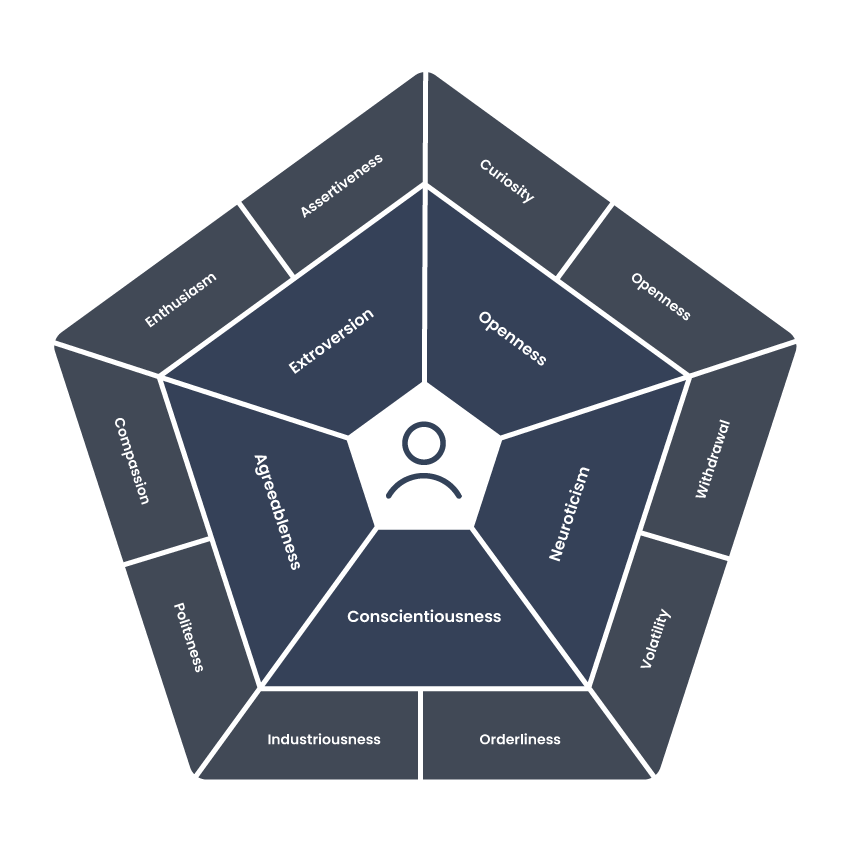
Fathom uses five top-level traits, each with two correlated sub-traits that capture the specific dimensions within each domain. This ten-factor structure provides enough granularity for meaningful self-understanding without the overwhelming complexity of clinical assessments.
Conscientiousness: Structure, Discipline, and Follow-Through
Conscientiousness describes your relationship with reliability, organisation, self-discipline, and achievement. High Conscientiousness tends to show up as strong planning, delivering on time, and careful deliberate action. Low Conscientiousness tends to show up as flexibility, spontaneity, and tolerance for ambiguity - but also higher risk of procrastination and inconsistency if unmanaged.
Research by Brent Roberts and colleagues, published in Psychological Bulletin, identified Conscientiousness as the single strongest personality predictor of job performance across all occupational categories - a finding replicated across hundreds of studies. However, extreme high Conscientiousness carries its own risks: workaholism, perfectionism, and compulsive tendencies where self-worth becomes entangled with performance.
The two sub-traits are Industriousness (forward planning, hard work, low procrastination) and Orderliness (need for tidiness, structured systems, predictable routines). High Industriousness combined with low Orderliness produces the person who works relentlessly but lives in creative chaos. The reverse - low Industriousness, high Orderliness - produces meticulous systems that never quite translate into output.
Heritability: approximately 49%. The common trap: high Conscientiousness becomes identity. When performance dips - through illness, career disruption, or life transition - identity collapses alongside it. This is especially relevant for executives and professionals navigating AI displacement, where previous performance metrics may suddenly become irrelevant. Fathom's Strengths framework (particularly Relevance) addresses this structural challenge directly.
Agreeableness: Harmony, Compassion, and Boundaries
Agreeableness describes how you feel and act towards others - the degree to which you prioritise harmony, cooperation, and trust. High Agreeableness tends to show up as being collaborative, compassionate, and conflict-avoidant. Low Agreeableness tends to show up as being analytical, tough-minded, competitive, and direct.
The two sub-traits are Compassion (caring orientation, genuine concern for others, service-mindedness) and Politeness (desire not to offend, avoidance of conflict). The distinction matters: a person can be deeply compassionate but direct in communication (high Compassion, low Politeness) or socially smooth but emotionally detached (low Compassion, high Politeness).
Heritability: approximately 42%. Research on Agreeableness and career outcomes presents a nuanced picture. A study by Timothy Judge and colleagues in the Journal of Applied Psychology found that higher Agreeableness correlated with lower earnings - not because agreeable people are less capable, but because they are less likely to negotiate assertively or advocate for themselves. This finding is particularly relevant in professional contexts where boundary-setting and self-advocacy directly affect career trajectory.
The common trap: high Agreeableness becomes weak boundaries, especially in work settings - being exploited, failing to speak up, absorbing other people's workload while your own priorities erode. In Fathom, this is where Principles become critical. A principle like I protect my commitments before accepting new ones gives the highly agreeable person a pre-committed decision rule that does not require in-the-moment assertiveness.
Openness: Curiosity, Creativity, and Complexity
Openness to Experience describes curiosity, creativity, and comfort with novelty and complexity. High Openness tends to show up as being inventive, idea-rich, and open to unconventional thinking. Low Openness tends to show up as being conventional, routine-oriented, and preferring familiar structure - not inferior, but often stabilising.
The two sub-traits are Curiosity (love of complex problems, quick learning, tolerance for ambiguity) and Openness as a facet (appreciation for aesthetics, creativity needs, sensitivity to ideas and beauty). High Curiosity is a strong predictor of happiness according to research by Todd Kashdan published in Clinical Psychology Review, while the aesthetic facet of Openness drives the need for creative outlets and meaningful work.
Heritability: approximately 57% - the highest among the five traits. This means Openness is the dimension most strongly influenced by genetic predisposition, which has implications for how realistic it is to develop curiosity in someone who does not naturally possess it (difficult) versus creating environments that channel existing curiosity productively (more effective).
The common trap: high Openness creates breadth without depth - "possibility addiction" replaces execution. The highly open professional generates ideas endlessly, starts projects compulsively, and finishes few of them. In the Fathom system, this is where Conscientiousness provides the counterweight, and where Pursuit-based Principles (I finish what I start unless evidence changes) provide the structural discipline that Openness alone does not supply.
Neuroticism: Emotional Reactivity and Stress Response
Neuroticism describes emotional reactivity and vulnerability to stress - the tendency toward negative emotion, threat-interpretation bias, and persistence of negative reactions. High Neuroticism tends to show up as being emotionally reactive, interpreting ordinary situations as threatening, and experiencing greater emotional pain. Low Neuroticism (high emotional stability) tends to show up as calm, steady responses - not necessarily high positivity (which correlates more with Extraversion), but lower negative affect volatility.
The two sub-traits are Volatility (agitation, anger-proneness, quick mood shifts) and Withdrawal (embarrassment-proneness, overwhelm, avoidance under stress). The distinction matters for intervention design: Volatility responds better to emotion regulation strategies, while Withdrawal responds better to graduated exposure and confidence-building.
Heritability: approximately 48%. Research by Lahey, published in American Psychologist, identified Neuroticism as the single trait most predictive of mental health difficulties across the lifespan - but also noted that moderate Neuroticism can serve a protective function by increasing vigilance and conscientiousness in genuinely threatening environments. The key is whether the threat response matches reality.
The common trap: high Neuroticism gets mislabelled as "overthinking" when it is often a threat-bias combined with poor recovery. In Fathom, the Drivers framework - particularly Presence and Perspective - provides the diagnostic tools to distinguish between genuine risk assessment and anxiety-driven catastrophising. Perspective Principles like I do not catastrophise temporary setbacks operationalise this distinction into daily decision-making.
How Traits Interact With the Rest of the System
The critical insight in Fathom is that traits shape defaults, but defaults are not destiny. Here is how traits interact with the chain of belief, behaviour, and aspiration:
Traits shape your default interpretations (how you initially read situations), your default behaviours (how you act when you are not being deliberate), and your felt effort (what drains versus energises you). But traits should not define your identity, and must not cap your aspirations.
A practical example: low Extraversion may make networking feel draining (trait → energy). That may produce a belief: "I'm not good at relationships" (trait → belief). That belief reduces action (belief → behaviour). And then ambition quietly shrinks (behaviour → outcome). Fathom's purpose is to interrupt this chain early - before trait-driven comfort becomes life-limiting avoidance.
Values operate independently of Traits. An introvert and an extravert can both deeply value connection - they will simply express it differently. Understanding this prevents designing a value system that is actually a personality profile in disguise.
Principles must account for Traits. A highly agreeable person needs boundary principles. A highly open person needs completion principles. A highly neurotic person needs perspective principles. Trait-informed Principle design produces rules that work with your wiring rather than against it.
Drivers are shaped by trait interactions. High Neuroticism can suppress Presence. Low Conscientiousness can undermine Pursuit. High Openness without grounding can create an illusion of Perspective that is actually unfocused exploration. Trait-Driver interactions explain why the same Driver deficit manifests differently in different people.
Habits must be designed around Traits. Research by Wendy Wood at the University of Southern California, published in Annual Review of Psychology, demonstrated that habit formation depends heavily on environmental design and friction reduction - both of which vary by trait profile. A highly conscientious person can build habits through discipline alone; a person lower in Conscientiousness needs environmental scaffolding, accountability structures, and lower-friction habit designs.
Pillars receive different natural investment depending on Traits. High Conscientiousness supports the Work Pillar. High Agreeableness may strengthen Connection but create difficulty in Work boundary-setting. Understanding your trait profile prevents designing a Pillar balance that fights your wiring.
Common Trait Distortions and How Fathom Addresses Them
Using traits as excuses. "I can't help it - I'm an introvert" is not trait-awareness. It is trait-justification. Fathom treats traits as design constraints, not permission to avoid growth.
Confusing states with traits. A bad month is not a personality. Sleep deprivation, stress, grief, and overwhelm produce temporary states that mimic trait patterns. Fathom distinguishes between traits (longer-term tendencies) and states (temporary conditions) to prevent misdiagnosis.
Type-based thinking. Category systems (you are an INTJ, you are a Type 3) create identity boxes. The Five-Factor Model's continuous scales avoid this - you are not "an introvert" or "an extravert" but somewhere on a spectrum, and most people sit near the middle rather than at the extremes.
Extreme scores as identity. High Conscientiousness becoming workaholism. High Openness becoming inability to commit. High Agreeableness becoming inability to say no. Traits at the extremes carry specific risks, and an honest review of your Habits often reveals where an extreme trait expression has hardened into a compensatory default.
How to Use Your Trait Profile: A Practical Guide
Step 1: Assess Honestly. Complete the Fathom Traits assessment, which measures all five traits and ten sub-traits on continuous scales. Approach it as a description of current tendencies, not a permanent verdict. The goal is accuracy, not a flattering result.
Step 2: Identify Your Friction Points. Where do your traits create recurring difficulty? Low Conscientiousness and procrastination. High Neuroticism and decision paralysis. High Agreeableness and boundary erosion. These friction points are where targeted intervention produces the greatest return.
Step 3: Design Around Your Wiring. Use trait-awareness to build Habits, Principles, and environmental systems that work with your profile rather than against it. An introvert does not need to become an extravert to build a strong network - they need a networking strategy designed for introversion.
Step 4: Challenge Your Comfortable Limits. Trait-awareness should expand your life, not confirm its boundaries. Identify one area where a trait has become a ceiling rather than a description, and design a deliberate override - a Habit or Principle that pushes past the comfortable default.
Step 5: Revisit as Context Changes. Traits are stable but not immutable. Research shows modest trait change across adulthood - people generally become slightly more conscientious, more agreeable, and less neurotic with age. More importantly, life transitions (career change, parenthood, relocation) can shift the functional expression of traits. Reassess annually within Fathom to keep your self-understanding current.
Start Understanding Your Traits
The Traits framework is one component of Fathom's integrated personal development system - a structured approach to self-understanding, intentional living, and behavioural evidence for executives and professionals navigating complexity. Traits explain your wiring. What you do with that wiring is up to you. Explore how Fathom works or get started today.
FAQ
Frequently Asked Questions
What personality model does Fathom use?
Fathom uses the Five-Factor Model (Big Five) - the most widely researched and empirically validated personality framework in psychology. It measures five core traits (Extraversion, Conscientiousness, Agreeableness, Openness, Neuroticism) each with two sub-traits, on continuous scales rather than categories. This avoids the reductive labelling of type-based systems like Myers-Briggs or Enneagram.
Can personality traits change?
Traits are stable but not fixed. Research published in the Journal of Personality and Social Psychology has shown modest trait change across adulthood - most people become slightly more conscientious and agreeable over time. However, dramatic personality change is rare. Fathom's approach is not to change your traits but to design systems - Habits, Principles, environments - that work with your wiring while preventing it from limiting your ambitions.
How are traits different from values?
Traits describe how you are wired - your default energy patterns, emotional responses, and behavioural tendencies. Values describe what matters to you - the enduring priorities that give life meaning. An introvert and an extravert can share identical values but express them in entirely different ways. In Fathom, Traits and Values are explored as separate dimensions that interact but do not determine each other.
What if I score high on Neuroticism?
High Neuroticism means greater emotional reactivity and vulnerability to stress - but it is not a defect. Moderate Neuroticism can increase vigilance and conscientiousness in genuinely challenging environments. Fathom addresses high Neuroticism through Perspective Principles (decision rules for interpreting difficulty), Presence-building Habits, and diagnostic tools in the Drivers framework that help distinguish genuine risk assessment from anxiety-driven catastrophising.
Why doesn't Fathom use Myers-Briggs or Enneagram?
Type-based systems sort people into categories (you are an INTJ, you are a Type 4), which creates identity boxes that can limit growth. The Five-Factor Model measures traits on continuous scales - you are not "an introvert" but somewhere on the Extraversion spectrum. This approach aligns with Fathom's core principle that traits should inform strategy, not define identity. The Five-Factor Model also has vastly stronger empirical support, with thousands of peer-reviewed studies validating its structure and predictive validity.
About The Author
Dan Ford, Executive Career Coach & Founder of Fathom
Dan Ford is an executive career coach and the creator of Fathom - a personal development system for executives and professionals navigating complexity, career uncertainty, and rapid technological change. Drawing on the Five-Factor Model, Self-Determination Theory, Stoic philosophy, and a decade of experience coaching professionals through high-stakes transitions, Fathom provides the structured self-examination that generic apps and expensive coaching alternatives cannot.
About FathomThe Framework
Explore the Full System
Explore
Values
“What actually matters?”
The enduring priorities that determine what feels meaningful, what motivates effort, and how fulfilment is evaluated.
Read more
Traits
“How am I wired?”
Stable personality tendencies that influence energy, sensitivity, friction, and behavioural defaults. Based on the Five-Factor Model.
You Are Here
Principles
“How do I choose to act?”
Explicit decision rules that govern behaviour when values conflict, pressure is high, or clarity is missing.
Read more
Evaluate
Pillars
“Where is life happening?”
Six domains - Work, Wellbeing, Wealth, Recreation, Connection, Environment - that reveal allocation of energy and domain imbalance.
Read more
Drivers
“How is life actually being lived?”
Four dynamic conditions - Presence, Purpose, Perspective, Pursuit - that rise and fall depending on attention, choices, and circumstances.
Read more
Strengths
“Is growth structurally possible?”
Four structural enablers - Relevance, Reputation, Relationships, Resources - that determine whether effort is viable.
Read more
Execute
Goals
“Where am I heading?”
Direction, not identity. Goals clarify intended movement. They are optional within the system - they prevent stagnation, but they do not define you.
Read more
Habits
“What am I doing, repeatedly, on purpose?”
Observable, repeatable, trackable actions. Strategic daily investments that compound over time to shape identity and outcomes.
Read more
Tasks
“What am I doing about it today?”
The atomic unit of Execute. Concrete, completable actions that turn each week’s 168 hours into visible daily progress.
Read more
Stop Drifting. Start Building.
Fathom is a personal development system for professionals who take their future seriously. One system. Full access to everything.
Where Are You in the Transition?
14-day cooling-off period. Cancel anytime. No tiers. No upsells.