
Explore
Understanding Your Values: The Hidden Drivers Behind Every Decision You Make
Values are the enduring priorities that determine what matters to you, what feels meaningful, and what makes life feel worth living. In Fathom's personal development system, Values function as motivational drivers, decision-making criteria, and sources of meaning - shaping what you move towards, what you avoid, and how you evaluate your life. They are not aspirational ideals. They are revealed through what consistently energises, frustrates, or fulfils you.
Without clarity on Values, goals become hollow or externally driven, motivation fluctuates or collapses under pressure, decisions feel conflicted or reactive, and success can increase while fulfilment declines. Many people live according to borrowed values - inherited from family, culture, peers, or organisations - without ever consciously examining whether those values are truly their own. The result is a life that looks right from the outside but feels wrong from the inside.
The Fathom Values framework draws on three philosophical traditions - Stoicism (virtue and internal alignment as the basis of a good life), Taoism (Wu Wei - acting in accordance with one's true nature), and Buddhist psychology (awareness of desire and attachment as pathways to clarity) - alongside the empirical foundation of Self-Determination Theory developed by Edward Deci and Richard Ryan. SDT research has consistently demonstrated that individuals who organise their lives around intrinsic values report higher life satisfaction, greater psychological resilience, and more sustained motivation than those dominated by extrinsic pursuits. A 2020 meta-analysis published in the Journal of Personality and Social Psychology confirmed this pattern across cultures, age groups, and economic contexts.
Within the Fathom personal development system, Values sit in Explore Mode - upstream of everything else. Traits describe how you are wired. Values determine why something matters. Principles translate Values into rules for behaviour. Habits operationalise Values through daily action. Values do not dictate capability or personality. They determine priority, meaning, and motivation.
By Dan Ford · August 2026
The Article
Values
What Are Values in the Fathom Framework?
Values in Fathom are treated as discoverable, testable, and refinable - not as fixed declarations carved into stone. They operate beneath goals and behaviours, shaping how you interpret success, satisfaction, and fulfilment. The purpose of the Values concept is to restore agency over what drives your life, reduce internal conflict, align effort with meaning, and prevent long-term dissatisfaction caused by value misalignment.
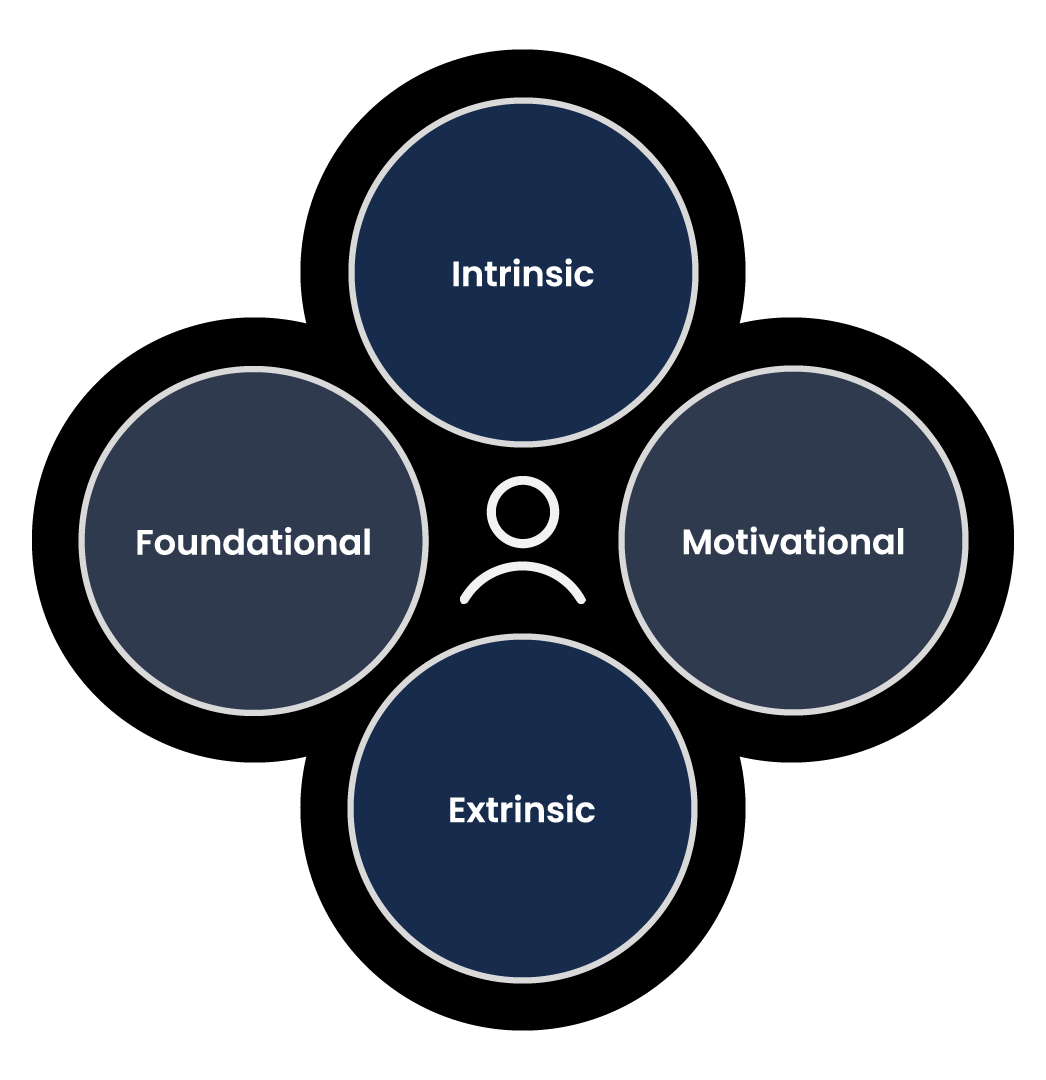
Fathom organises Values into four complementary dimensions. These are not categories to pick from, but lenses for understanding how values operate in your life:
- Intrinsic Values - internally rewarding priorities pursued for their own sake
- Extrinsic Values - priorities oriented around external outcomes and recognition
- Foundational Values - ethical and character-based standards that guide behaviour
- Motivational Values - energising priorities that direct effort toward future outcomes
Intrinsic Values: The Psychological Bedrock of Fulfilment
Intrinsic Values are internally rewarding. They are pursued for their own sake because they align with your core sense of self. Examples include personal growth, inner peace, authenticity, learning, creativity, meaningful connection, and wellbeing.
Deci and Ryan's Self-Determination Theory provides the strongest empirical support for the primacy of intrinsic values. Their research, spanning four decades and hundreds of studies, demonstrates that intrinsic motivation - doing something because it is inherently interesting or satisfying - produces more sustained engagement, higher quality performance, and greater psychological wellbeing than extrinsic motivation. A 2022 study published in Motivation and Emotion found that professionals whose career decisions were guided primarily by intrinsic values reported 40% higher job satisfaction and significantly lower burnout rates than those guided primarily by extrinsic rewards.
High Intrinsic Values show up as satisfaction that comes from the activity itself, motivation sustained without external validation, and resilience during setbacks because the underlying drive does not depend on outcomes. Low or suppressed Intrinsic Values show up as chronic dissatisfaction despite outward success, burnout driven by external pressure, and loss of meaning during transitions.
The common distortion is treating intrinsic values as impractical - a luxury for people who do not have bills to pay. In reality, intrinsic values form the psychological bedrock of fulfilment. When these are unclear or suppressed, no amount of achievement compensates. This is the professional who reaches every milestone and feels nothing - a pattern Fathom's Drivers framework diagnoses as low Presence combined with high Pursuit.
Extrinsic Values: Ambition Without the Anchor
Extrinsic Values are oriented around external outcomes, recognition, or rewards. Examples include wealth, status, influence, recognition, prestige, and visible success.
Extrinsic Values are not inherently negative - this is a critical distinction that much of the personal development industry gets wrong. Extrinsic motivation can drive ambition, progress, and achievement. Status and recognition are legitimate human needs, and pretending otherwise creates a different kind of misalignment. Research by Kennon Sheldon, published in the Journal of Research in Personality, has shown that the healthiest psychological profiles combine strong intrinsic motivation with moderate extrinsic motivation - not the absence of extrinsic values, but their proper subordination.
The problem is imbalance. When extrinsic values dominate without intrinsic grounding, motivation becomes fragile and conditional, self-worth ties to performance or approval, and success arrives without satisfaction. Tim Kasser's extensive research on materialism and wellbeing, summarised in The High Price of Materialism, found that individuals who prioritise extrinsic values (financial success, image, popularity) over intrinsic values consistently report lower life satisfaction, more anxiety, and weaker interpersonal relationships - a pattern that holds regardless of actual income level.
For Fathom's target audience - executives and professionals navigating uncertainty - the extrinsic-intrinsic tension is particularly acute. Career disruption strips away many extrinsic validators (title, status, income trajectory) simultaneously. Professionals whose value system is primarily extrinsic experience this as an identity crisis. Those with strong intrinsic grounding experience it as a transition - difficult, but navigable.
Foundational Values: The Standards That Anchor Behaviour
Foundational Values describe the ethical and character-based standards that guide how you behave in the world. Examples include integrity, honesty, fairness, responsibility, compassion, and respect.
The Stoic philosophical tradition provides the deepest treatment of foundational values. Marcus Aurelius, Seneca, and Epictetus all argued that virtue - understood as consistent alignment between belief and action - is the only reliable source of inner peace. Modern psychology has validated this insight. Research on moral identity by Aquino and Reed, published in the Journal of Personality and Social Psychology, found that individuals with strong, clearly defined ethical standards show greater behavioural consistency, higher self-esteem, and more stable relationships than those whose ethical boundaries are vague or situational.
Foundational Values are characteristically stable across life stages, inform trust, boundaries, and self-respect, and shape how decisions are made under pressure. When they are violated - even in small, rationalised ways - people experience guilt, resentment, or quiet self-disrespect, even if outcomes look successful from the outside.
The common distortion is using foundational values as moral identity rather than behavioural guidance - claiming integrity as a value while making repeated exceptions under pressure. In Fathom, Principles exist specifically to close this gap. Principles translate foundational values into explicit, testable decision rules that hold when pressure is high and rationalisation is easy.
Motivational Values: Direction and Drive
Motivational Values energise action and direct effort toward future outcomes. Examples include impact, contribution, mastery, leadership, innovation, growth, and achievement.
Motivational Values are closely tied to ambition and goal-setting. They drive momentum and sustained effort, and are often expressed through career, projects, or creative work. Research on goal-setting by Edwin Locke and Gary Latham, published in their comprehensive review in American Psychologist, demonstrated that goals aligned with personal values produce significantly higher commitment and performance than goals imposed externally - a finding that directly supports Fathom's approach of clarifying values before setting goals.
High Motivational Values show up as clear direction, sustained effort, and engagement that feels purposeful rather than draining. Misaligned Motivational Values show up as chasing goals that do not truly matter, high effort with low emotional return, and confusion between ambition and meaning.
The critical insight is that Motivational Values only function well when aligned with Intrinsic and Foundational Values. A professional motivated by impact (motivational) but disconnected from authenticity (intrinsic) and integrity (foundational) will pursue achievement in ways that ultimately feel hollow. In the Fathom system, this is why Values are explored before Principles are defined and Habits are designed - the motivational layer must be grounded before execution begins.
How Values Reveal Themselves: Behaviour, Not Declarations
Values are revealed through behaviour, not declarations. This is one of the most important principles in the Fathom framework. What you say you value and what you actually value are often different - and the gap between them is where most internal conflict lives.
Behavioural signals of values include where time and energy naturally flow, what triggers frustration or resentment (which usually indicates a value being violated), what sacrifices feel worth making, and what feels empty even when achieved. Misalignment between stated and lived values often shows up as procrastination, disengagement, chronic dissatisfaction, or repeated cycles of success followed by collapse.
The common distortions are instructive: confusing stated values with lived values, inheriting values without examination, prioritising socially rewarded values at the expense of personal fulfilment, and treating values as fixed rather than evolving. Fathom treats values as discoverable, testable, and refinable over time - because circumstances change, understanding deepens, and what mattered at thirty may not be what matters at forty-five.
Value Tensions and Trade-Offs
Values rarely operate in isolation. They exist in tension with each other, and navigating these tensions consciously is one of the most important skills in intentional living. Common value tensions include intrinsic fulfilment versus extrinsic success, stability versus growth, freedom versus responsibility, and contribution versus self-preservation.
Fathom does not attempt to eliminate these tensions. They are inherent to a complex life. Instead, it helps individuals recognise trade-offs consciously, choose deliberately rather than reactively, and revisit values as life circumstances change. A professional who values both security and growth will face moments where these pull in opposite directions. Without awareness, the default is usually whichever value is reinforced by the immediate environment - which may not be the one that serves long-term fulfilment.
This is where Values connect to Principles. Where Values identify what matters, Principles create decision rules for how to navigate the tensions between competing values. A principle like I choose growth over comfort when the risk is recoverable resolves the stability-growth tension in advance, reducing the cognitive load of making that decision under pressure.
How Values Connect to the Rest of the System
Values interact with every other component in the Fathom framework:
Traits influence how easily certain values are expressed, but do not define them. An introvert may value connection deeply but express it through fewer, deeper relationships rather than broad social engagement. Understanding this interaction prevents designing a life that fights your wiring.
Principles are the bridge between Values and behaviour. Principles translate what matters into how you act - especially under pressure when values conflict.
Drivers are shaped by value alignment. High Purpose (a Driver) requires clarity of values. Low Purpose often signals value misalignment - effort directed toward goals that do not actually reflect what matters. The Presence Driver is strengthened when daily experience aligns with intrinsic values.
Pillars are the domains where values are expressed. Someone who values learning will invest heavily in the Work Pillar. Someone who values connection will prioritise the Connection Pillar. Values explain why Pillar allocation looks the way it does.
Strengths can constrain value expression. Weak Resources may prevent you from living according to a value of freedom. Weak Relevance may undermine a value of contribution. Structural problems can look like value problems - which is why Fathom insists on structural diagnosis alongside identity exploration.
Habits are values made visible through action. If you value learning but have no learning habits, the value is aspirational rather than lived. And the default habits you never consciously chose often stand in as short-term substitutes for unmet values - compulsive distraction compensating for unfulfilled creativity, overwork compensating for unacknowledged achievement needs.
How to Clarify Your Values: A Practical Guide
Clarifying values is not a one-time exercise. It is an ongoing process of observation, testing, and refinement. Here is a five-step process:
Step 1: Observe Behaviour, Not Beliefs. Rather than asking "What do I value?", look at where your time, energy, and emotion actually go. What do you do when no one is watching? What makes you angry when it is violated? What would you protect if forced to choose? Behaviour reveals values more reliably than reflection alone.
Step 2: Identify Borrowed Values. Examine which of your stated values were inherited from family, culture, or professional environments rather than consciously chosen. Borrowed values are not automatically wrong - but they must be examined. If a value was never consciously adopted, it may be driving behaviour that does not serve you.
Step 3: Map Across the Four Dimensions. Use Fathom's four value dimensions (Intrinsic, Extrinsic, Foundational, Motivational) to create a complete picture. Most people have blind spots - strong awareness of their motivational values but poor awareness of their intrinsic values, or clear foundational values but unexamined extrinsic drivers.
Step 4: Test for Alignment. Compare your value map against your current life allocation across the six Pillars. Where is alignment strong? Where is there a gap between what you value and where your energy goes? These gaps are where dissatisfaction lives - and where targeted Habit design produces the greatest impact.
Step 5: Revisit and Refine. Values evolve. What mattered during a career-building phase may shift during a consolidation phase. Fathom recommends revisiting your value assessment at least annually, or whenever a significant life transition creates a sense of misalignment. The Fathom app provides structured tools to make this process consistent and trackable.
Start Understanding Your Values
The Values framework is one component of Fathom's integrated personal development system - a structured approach to self-understanding, intentional living, and behavioural evidence for executives and professionals navigating complexity. Values are not what you declare. They are what your behaviour reveals. The first step is honest observation. Explore how Fathom works or get started today.
FAQ
Frequently Asked Questions
What is the difference between values and goals?
Goals describe outcomes you are working toward - they are future-directed and time-bound. Values describe what makes those outcomes worth pursuing. You might set a goal to earn a promotion, but the underlying value might be mastery, contribution, or security. In Fathom, values are explored in Explore Mode before goals are set in Execute Mode, because goals without value alignment produce achievement without fulfilment.
Can values change over time?
Yes. While foundational values (integrity, honesty) tend to remain stable, the relative priority of other values shifts with life circumstances, age, and experience. A young professional may prioritise growth and achievement; the same person at forty-five may prioritise meaning and balance. Fathom treats values as discoverable and refinable rather than fixed, and recommends periodic reassessment.
How are values different from principles?
Values describe what matters to you - the enduring priorities that give life meaning. Principles describe how you choose to act on those values - the explicit decision rules that govern behaviour under pressure. Values are the why. Principles are the how. In Fathom, Principles are derived from Values and serve as the bridge between identity and behaviour.
What if my values conflict with each other?
Value conflict is normal and expected. Most meaningful decisions involve tension between competing values - security versus growth, freedom versus responsibility, ambition versus presence. Fathom does not attempt to eliminate these tensions. Instead, it helps you recognise them consciously, develop Principles to navigate them, and make deliberate trade-offs rather than reactive ones.
How do values connect to career decisions?
Values provide the most reliable compass for career decisions because they persist when external conditions change. If you are considering a career move, assessing your value alignment reveals whether dissatisfaction stems from a misalignment between your values and your current role (a Values problem), weak Strengths (a structural problem), or a Driver imbalance (an experiential problem). Each diagnosis leads to a different response. The Values framework prevents reactive career decisions driven by vague dissatisfaction.
About The Author
Dan Ford, Executive Career Coach & Founder of Fathom
Dan Ford is an executive career coach and the creator of Fathom - a personal development system for executives and professionals navigating complexity, career uncertainty, and rapid technological change. Drawing on Self-Determination Theory, Stoic philosophy, and a decade of experience coaching professionals through high-stakes transitions, Fathom provides the structured self-examination that generic apps and expensive coaching alternatives cannot.
About FathomThe Framework
Explore the Full System
Explore
Values
“What actually matters?”
The enduring priorities that determine what feels meaningful, what motivates effort, and how fulfilment is evaluated.
You Are Here
Traits
“How am I wired?”
Stable personality tendencies that influence energy, sensitivity, friction, and behavioural defaults. Based on the Five-Factor Model.
Read more
Principles
“How do I choose to act?”
Explicit decision rules that govern behaviour when values conflict, pressure is high, or clarity is missing.
Read more
Evaluate
Pillars
“Where is life happening?”
Six domains - Work, Wellbeing, Wealth, Recreation, Connection, Environment - that reveal allocation of energy and domain imbalance.
Read more
Drivers
“How is life actually being lived?”
Four dynamic conditions - Presence, Purpose, Perspective, Pursuit - that rise and fall depending on attention, choices, and circumstances.
Read more
Strengths
“Is growth structurally possible?”
Four structural enablers - Relevance, Reputation, Relationships, Resources - that determine whether effort is viable.
Read more
Execute
Goals
“Where am I heading?”
Direction, not identity. Goals clarify intended movement. They are optional within the system - they prevent stagnation, but they do not define you.
Read more
Habits
“What am I doing, repeatedly, on purpose?”
Observable, repeatable, trackable actions. Strategic daily investments that compound over time to shape identity and outcomes.
Read more
Tasks
“What am I doing about it today?”
The atomic unit of Execute. Concrete, completable actions that turn each week’s 168 hours into visible daily progress.
Read more
Stop Drifting. Start Building.
Fathom is a personal development system for professionals who take their future seriously. One system. Full access to everything.
Where Are You in the Transition?
14-day cooling-off period. Cancel anytime. No tiers. No upsells.