
The Four Foundations Framework: Is the Ground You're Standing On Strong Enough?
By Dan Ford · February 2026
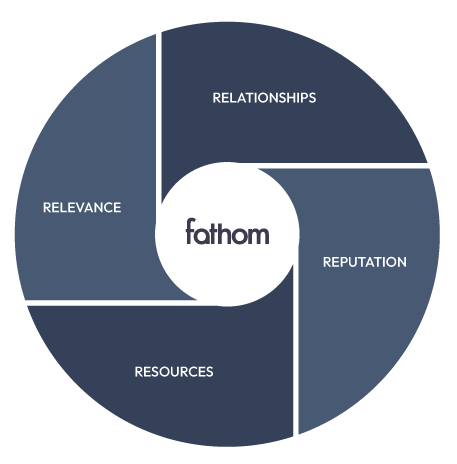
The Four Foundations — Relevance, Reputation, Relationships, and Resources — are the structural enablers that determine whether growth, ambition, and purpose are actually viable. Developed as part of Fathom's personal operating system, the Foundations framework diagnoses structural risk by revealing whether the conditions for sustained professional progress exist — or whether effort is being undermined before it begins.
Unlike Forces (which diagnose how life is being experienced) or Values (which clarify what matters), Foundations are not internal states. They are external and semi-external conditions that sit beneath performance, opportunity, and long-term viability. Most people frame career stagnation as an internal problem — more confidence, better habits, stronger mindset. In reality, stagnation often comes from foundational decay: skills that no longer match the market, reputation that is unclear or outdated, networks that are thin or misaligned, and resources that are constrained or poorly managed.
The framework is grounded in three established traditions: human capital theory (value is created through relevance and capability), social capital theory as articulated by Robert Putnam (opportunity flows through relationships), and identity and signalling theory from Erving Goffman's sociological research (reputation shapes trust and access). A 2022 study published in the Academy of Management Journal found that professionals who proactively maintained their skill relevance during periods of industry disruption were 2.6 times more likely to successfully transition to new roles than those who relied solely on existing expertise.
Within the Fathom personal operating system, Foundations sit in the Evaluate phase — between identity and execution. Traits describe how you are wired. Values describe what matters. Forces describe how life is being lived. Foundations describe whether growth is structurally possible. Weak Foundations undermine everything downstream — Habits become inconsistent, Principles lose traction, and Forces destabilise into burnout, anxiety, and drift.
What Are the Four Foundations?
The Four Foundations are Relevance, Reputation, Relationships, and Resources. Each Foundation represents a structural condition that must be maintained for professional and personal progress to be sustainable. Together, they answer a single, hard question: Is the ground I'm standing on strong enough to support where I want to go?
Think of Foundations as the load-bearing walls of a building. You can redesign the interior (habits, goals, mindset) as often as you like — but if the structure is compromised, nothing you build inside will hold. Many "motivation problems" are actually foundation problems. Many "mindset issues" are actually structural gaps dressed up in psychological language.
The four Foundations are:
- Relevance — whether what you offer still matters
- Reputation — how trust and credibility are established and perceived
- Relationships — the quality and reach of your professional connections
- Resources — the assets that support sustained action and choice
Foundation 1: Relevance — Staying Valuable in a Changing World
Relevance is the degree to which your skills, knowledge, thinking, and experience align with current and emerging needs. In an era of accelerating technological change and AI-driven disruption, relevance is dynamic, not static. What made you valuable five years ago may be depreciating faster than you realise.
Research from the World Economic Forum's 2023 Future of Jobs Report estimated that 44% of workers' core skills will be disrupted within the next five years — the highest rate of anticipated disruption since the report began tracking this metric. For mid-career professionals, this creates a specific vulnerability: the very expertise that built their career can become the anchor that prevents adaptation.
Relevance operates on three levels. Skill relevance is whether your technical and professional capabilities match what the market currently needs — not what it needed when you built your career. Intellectual relevance is whether your thinking and perspective remain current and useful — the ability to translate experience into insight that others find valuable today, not just historically. Contextual relevance is whether your experience applies to the environments and challenges that matter now.
The common distortion is confusing seniority with relevance — assuming that years of experience automatically translate into current value. High Relevance shows up as fluency with current tools and methods, an ability to translate experience into current value, and being sought for judgement rather than just knowledge. Low Relevance shows up as reliance on outdated expertise, resistance to change disguised as experience, and declining confidence despite past success.
In the Fathom system, Relevance is the foundation that determines whether opportunities appear at all. Without it, Reputation fades, Relationships weaken, and Resources shrink. In the context of career resilience in the AI age, maintaining Relevance is not optional — it is existential.
Foundation 2: Reputation — Trust, Credibility, and Signal
Reputation is the accumulated perception of your credibility, integrity, and capability — both online and offline. It is not what you claim. It is what others expect of you before you have said a word.
Erving Goffman's foundational work on social identity and self-presentation established that reputation functions as a signal — a mechanism through which trust is communicated without requiring direct proof every time. In professional contexts, reputation reduces friction. A strong reputation means people trust you before you have to prove yourself. A weak reputation means every interaction starts from zero.
Reputation in the modern professional landscape operates across two dimensions. Offline reputation is built through consistent behaviour, delivered results, and the quality of your professional relationships. It accrues slowly and compounds over years. High offline reputation shows up as being sought out rather than chasing, and consistency between what you say and what you do. Online reputation has become equally important — your digital presence now functions as a first impression that precedes physical interaction. Research from CareerBuilder has consistently shown that the majority of hiring managers review candidates' online presence before making decisions, and this extends far beyond hiring into partnerships, collaborations, and referrals.
The common distortions are instructive: confusing visibility with reputation (posting frequently is not the same as being trusted), outsourcing reputation entirely to platforms (if your professional identity exists only on LinkedIn, it is fragile), and avoiding self-definition entirely (which means others will define you, usually inaccurately).
Reputation converts Relevance into trust. Without it, skills go unnoticed, relationships stay shallow, and opportunities require constant justification. In the Fathom framework, Reputation is strengthened not through self-promotion but through the consistent expression of Principles — when your behaviour reliably matches your stated values, reputation compounds naturally.
Foundation 3: Relationships — Access, Collaboration, and Leverage
Relationships are the quality, depth, and strategic alignment of your professional connections. They are not a numbers game. They are an ecosystem that determines the flow of information, opportunity, and support through your professional life.
Robert Putnam's landmark research on social capital, published in Bowling Alone, demonstrated that the strength of an individual's relational network is one of the most reliable predictors of economic mobility, career resilience, and access to opportunity. More recently, network science research by Rob Cross at Babson College has shown that the structure of professional relationships — not just their quantity — predicts performance, innovation, and career advancement. Professionals with diverse, bridging networks consistently outperform those with larger but homogeneous ones.
Relationships in the Fathom framework are assessed across three qualities. Depth refers to the quality of trust and mutual understanding within your closest professional relationships — deep relationships provide candid feedback, genuine support, and access to opportunities that never reach the open market. Breadth refers to the diversity and reach of your network across industries, disciplines, and social contexts — providing exposure to new ideas, unexpected opportunities, and resilience against disruption. Alignment refers to whether your relationships are strategically connected to your current direction and values — misaligned relationships drain energy while well-aligned ones energise naturally.
The common distortions are transactional networking (treating relationships as a numbers game), over-reliance on a small homogeneous circle, and confusing social activity with genuine relational depth. The professional who attends every conference but has no one to call during a career crisis has breadth without depth.
Relationships provide flow — of information, opportunity, and support. Without them, Relevance decays faster (you miss signals about where the market is moving), Reputation has limited reach (no one amplifies your credibility), and Resources are harder to access (every resource requires individual negotiation rather than network leverage).
Foundation 4: Resources — Capacity to Act and Choose
Resources are the assets that give you room to manoeuvre — financial, temporal, cognitive, and structural. Resources are what turn intention into optionality. Without sufficient resources, even the clearest Values, strongest Principles, and most accurate Force diagnosis cannot translate into meaningful change.
Research on scarcity by Sendhil Mullainathan and Eldar Shafir, published in their book Scarcity: Why Having Too Little Means So Much, demonstrated that resource constraint does not merely limit options — it actively degrades cognitive function. People operating under financial or temporal scarcity show measurably reduced decision-making quality, reduced capacity for long-term planning, and increased susceptibility to short-term thinking. This has direct implications for personal development: if your resources are depleted, the cognitive bandwidth required for intentional change simply is not available.
Resources in the Fathom framework span four categories. Financial runway is the buffer that separates you from desperation — not wealth, but margin. Sufficient runway shows up as ability to invest in change and capacity to absorb setbacks; insufficient runway shows up as short-term survival thinking and fear-based decision-making. Time and energy are the resources most consistently underestimated — a professional overcommitted across every waking hour has no capacity for the reflection and experimentation that growth requires. Systems and tools are the structural resources that reduce friction in daily execution, including the Habits tracking system itself. Optionality and margin is the meta-resource — the aggregate capacity to make choices without being forced into them.
The common distortions are optimising income without margin (earning more but saving nothing), treating busyness as productivity (filling every hour without strategic allocation), and ignoring cognitive and emotional resources entirely.
Resources enable action without desperation. Without them, aspiration shrinks, behaviour becomes reactive, and Forces destabilise.
Why Foundations Matter: Common Failure Patterns
Foundations are mutually reinforcing — strength in one tends to build strength in the others, and weakness in one eventually erodes them all. The reinforcing cycle works like this: Relevance strengthens Reputation (being good at what matters earns trust). Reputation accelerates Relationships (credibility attracts high-quality connections). Relationships expand Resources (networks provide access to opportunities, information, and support). Resources create space to maintain Relevance (margin enables continued learning and adaptation).
Understanding the common failure patterns helps identify where intervention is most needed:
High Relevance, low Reputation produces under-recognised expertise. You are genuinely skilled and current, but no one knows it. The intervention is visibility and communication, not more skill development.
Strong Reputation, weak Relevance produces slow decline. You are coasting on a reputation built from past achievements while the underlying capability erodes. This is perhaps the most dangerous pattern because it is invisible until a crisis forces a reckoning.
Good Relationships, weak Resources produces dependency. Your network is strong, but you lack the financial or temporal resources to act on the opportunities it provides. You know the right people but cannot say yes when it matters.
Strong Resources, weak Relevance produces eventual stagnation. Financial security and time availability mask the fact that your professional value is declining. Comfort without currency.
These patterns reveal a critical insight: the Foundation that needs attention is rarely the one you are instinctively drawn to strengthen. Professionals tend to over-invest in their strongest Foundation and neglect the weakest — which is precisely where decay accelerates.
How Foundations Connect to the Rest of the System
Foundations interact with every other component in the Fathom framework:
Traits influence how easily you build and maintain each Foundation. High Conscientiousness supports the consistent effort required to maintain Relevance. High Extraversion may make Relationship-building more natural. Understanding your trait profile helps you design realistic Foundation-strengthening strategies.
Values determine which Foundations feel most meaningful. Someone who values autonomy will prioritise Resources (financial runway and optionality). Someone who values contribution will prioritise Relevance and Reputation.
Forces are directly affected by Foundation strength. Weak Relevance undermines Pursuit (why aspire when your professional value is declining?). Weak Resources destabilise Presence (scarcity pulls attention into anxious future-projection). Many Force imbalances that appear psychological are actually structural — a Foundation problem wearing a Force disguise.
Pillars provide the domains where Foundations operate. Your Work Pillar draws on Relevance and Reputation. Your Wealth Pillar is shaped by Resources. Your Connection Pillar intersects with Relationships — though Connection measures experiential quality while Relationships measures structural access.
Habits are the mechanism through which Foundations are maintained. A weekly learning habit maintains Relevance. A consistent content habit builds Reputation. Regular relationship investment prevents network decay. Habits without Foundation awareness risk becoming busywork — tracking behaviour that does not address the structural gaps that actually matter.
Vices often compensate for weak Foundations. Compulsive social media checking may signal anxiety about Reputation. Overwork may signal fear about Relevance. In Fathom, Vices are not moral failures — they are signals that reveal where the system is under structural stress.
How to Use the Foundations Framework: A Practical Guide
Applying the Foundations framework requires honest structural assessment — not aspiration, not intention, but clear-eyed evaluation of where you actually stand. Here is a five-step process:
Step 1: Audit Each Foundation Honestly. Rate each of the four Foundations on a simple scale. Where is your structural position strongest? Where is it weakest? Fathom's built-in assessment tools guide this process, but even a straightforward self-assessment is valuable. The key is to evaluate evidence rather than feeling — not "Do I feel relevant?" but "What evidence exists that my skills match current market needs?"
Step 2: Identify the Weakest Link. Foundations are a chain — the weakest link determines structural integrity. Identify which Foundation, if it failed, would cause the most damage to your professional position. That is your priority, regardless of which Foundation feels most comfortable to work on.
Step 3: Distinguish Foundation Problems from Force Problems. Before prescribing more habits, more mindset work, or more goal-setting, ask whether the real issue is structural. If you feel unmotivated at work, is it a Purpose problem (Force) or a Relevance problem (Foundation)? If you feel anxious about the future, is it a Perspective problem (Force) or a Resources problem (Foundation)? The intervention is radically different depending on the diagnosis. This is why Fathom insists that diagnosis precedes prescription.
Step 4: Design Foundation-Specific Habits. Once you have identified the weak Foundation, create specific Habits that address the structural gap. For Relevance: a weekly learning or skill-development habit. For Reputation: a regular content or visibility habit. For Relationships: a consistent outreach and deepening habit. For Resources: a financial review or margin-building habit. Anchor each habit to the relevant Pillar for context.
Step 5: Reassess Quarterly. Foundations change more slowly than Forces but they do change — particularly during career transitions, economic shifts, or industry disruptions. Fathom recommends a quarterly Foundation assessment to catch decay before it becomes crisis. The AI-driven economy means that Relevance in particular can shift faster than most professionals expect.
The goal is not to maximise every Foundation simultaneously. The goal is structural awareness — knowing where you stand, where decay is occurring, and where targeted investment will produce the greatest return.
The Intellectual Roots of the Foundations Framework
The Fathom Foundations Framework draws on established traditions that converge on a single insight: conditions matter as much as character.
Human capital theory, developed by economists Gary Becker and Theodore Schultz, established that an individual's economic value is determined by their skills and capabilities — and that these depreciate over time without active investment. The Relevance Foundation applies this directly: your professional value is a depreciating asset that requires ongoing maintenance.
Social capital theory, particularly as articulated by Robert Putnam and Pierre Bourdieu, demonstrated that the structure of social connections predicts access to opportunity more reliably than individual talent alone. The Relationships Foundation operationalises this: your network is an ecosystem that either amplifies or constrains your potential.
Identity and signalling theory, rooted in Goffman's sociological research and Michael Spence's economic work on market signalling, explains how Reputation functions. In contexts of imperfect information — which describes every professional interaction — signals substitute for direct knowledge. Reputation is the accumulated signal that precedes you.
Scarcity theory, as developed by Mullainathan and Shafir, provides the psychological foundation for the Resources concept. Resource constraint does not merely limit options — it actively degrades cognitive function. This is why Fathom treats Resources as a Foundation rather than a secondary concern.
Together, these traditions support a structural view of personal development that complements the experiential view provided by Forces. Forces diagnose how life feels. Foundations diagnose whether the conditions for change actually exist.
Start Assessing Your Foundations
The Foundations framework is one component of Fathom's integrated personal operating system — a structured approach to self-understanding, intentional living, and behavioural evidence for mid-career professionals navigating complexity. Many motivation problems are actually foundation problems. Many mindset issues are actually structural gaps. The first step is honest diagnosis. Explore how Fathom works or get started today.
FAQ
Frequently Asked Questions
About the Author
Dan Ford, Executive Career Coach & Founder of Fathom
Dan Ford is an executive career coach and the creator of Fathom — a personal operating system for mid-career professionals navigating complexity, career uncertainty, and rapid technological change. Drawing on human capital theory, social capital research, and two decades of experience coaching professionals through high-stakes transitions, Fathom provides the structured self-examination that generic apps and expensive coaching alternatives cannot.
The Framework
Explore the Full System
Explore
Traits
“How am I wired?”
Stable personality tendencies that influence energy, sensitivity, friction, and behavioural defaults. Based on the Five-Factor Model.
Read moreValues
“What actually matters?”
The enduring priorities that determine what feels meaningful, what motivates effort, and how fulfilment is evaluated.
Read morePrinciples
“How do I choose to act?”
Explicit decision rules that govern behaviour when values conflict, pressure is high, or clarity is missing.
Read moreEvaluate
Forces
“How is life actually being lived?”
Four dynamic conditions – Presence, Purpose, Perspective, Pursuit – that rise and fall depending on attention, choices, and circumstances.
Read morePillars
“Where is life happening?”
Six domains – Work, Wellbeing, Wealth, Recreation, Connection, Environment – that reveal allocation of energy and domain imbalance.
Read moreFoundations
“Is growth structurally possible?”
Four structural enablers – Relevance, Reputation, Relationships, Resources – that determine whether effort is viable.
You are hereExecute
Goals
“Where am I heading?”
Direction, not identity. Goals clarify intended movement. They are optional within the system – they prevent stagnation, but they do not define you.
Read moreProjects
“How am I actually going to get there?”
The structured layer between aspirational goals and daily behaviour. Projects turn direction into a credible plan — with defined initiatives, allocated time, and priority tasks.
Read moreHabits
“What am I doing, repeatedly, on purpose?”
Observable, repeatable, trackable actions. Strategic daily investments that compound over time to shape identity and outcomes.
Read moreVices
“Where am I compensating instead of choosing?”
Behaviours that provide short-term relief while undermining long-term alignment. Not moral failures – signals.
Read moreStop Drifting. Start Building.
Fathom is a personal development system for professionals who take their future seriously. One system. One price. Full access to everything.
Where Are You in the Transition?
Take The AssessmentGet Started for £149 →14-day cooling-off period. Cancel anytime. No tiers. No upsells.
We use analytics cookies to understand how Fathom is used. You can change this at any time on our Cookie Policy page.