
Understanding Your Vices: Why Bad Habits Are System Signals, Not Character Flaws
By Dan Ford · February 2026
Vices are behaviours that provide short-term relief or reward while undermining long-term outcomes. In Fathom's personal operating system, Vices are not moral failures — they are signals. They indicate neglected Forces, weakened Foundations, misaligned Principles, or poorly designed Habits. Fathom treats Vices as trackable behaviours, not character flaws, and uses them as diagnostic tools to reveal where the system needs attention.
Most personal development frameworks either ignore destructive behaviours entirely or moralise them into shame and guilt. Fathom does neither. Vices exist because humans seek relief under pressure, behaviour follows reward rather than intention, and unexamined patterns escalate quietly. The Vices concept answers one hard but necessary question: What am I repeatedly doing that feels good now, but costs me later? Without this layer, habit tracking becomes dishonest, balance becomes performative, and progress stalls without explanation.
Research on self-regulatory failure by Roy Baumeister and Todd Heatherton, published in Psychological Bulletin, found that the vast majority of maladaptive behaviours follow a consistent pattern: they emerge when self-regulatory capacity is depleted by stress, fatigue, or emotional overwhelm. This is not a willpower problem — it is a capacity problem. A 2019 study published in Health Psychology by Adriaanse and colleagues confirmed that habit-based interventions targeting the environmental and emotional triggers of unwanted behaviours are approximately twice as effective as willpower-based approaches, directly supporting Fathom's signal-based rather than suppression-based approach.
Within the Fathom personal operating system, Vices sit in the Execute phase alongside Goals and Habits — forming the complete behavioural evidence layer. Habits represent intentional, value-aligned execution. Vices represent compensatory, avoidance-based execution. Everything else in Fathom diagnoses or governs. Only Habits and Vices are tracked, because they are where truth is revealed. This is Fathom's core design principle: behaviour matters more than intention.
What Makes a Vice a Vice?
A Vice is not defined by what it is, but by how it functions. The same behaviour can be neutral, beneficial, or a Vice depending on context. A glass of wine at dinner is not a Vice. A glass of wine every evening to numb the anxiety of a career that feels directionless is a Vice — not because of the wine, but because of the function it serves.
In Fathom, a behaviour becomes a Vice when it meets five criteria:
Provides short-term reward or relief. The behaviour delivers an immediate positive sensation — comfort, distraction, numbing, or pleasure — that temporarily reduces discomfort.
Is used repeatedly to manage discomfort. The behaviour is not occasional indulgence but a recurring response to stress, boredom, anxiety, or emotional pain. It has become a default coping mechanism.
Undermines long-term goals, wellbeing, or integrity. The short-term relief comes at a long-term cost — to health, relationships, professional performance, financial stability, or alignment with Values and Principles.
Escalates under stress or fatigue. When pressure increases, so does the behaviour. This is the clearest diagnostic signal: a behaviour that intensifies during difficult periods is almost certainly functioning as a compensatory mechanism.
Resists moderation despite awareness. You know the behaviour is problematic. You may have tried to reduce or stop it. But it persists — not because you lack discipline, but because the underlying need it serves has not been addressed.
Context determines classification. Fathom does not maintain a list of "Vice behaviours" — it provides a framework for assessing whether any behaviour is functioning as a Vice in your specific situation.
The VICES Framework: A Diagnostic Progression Model
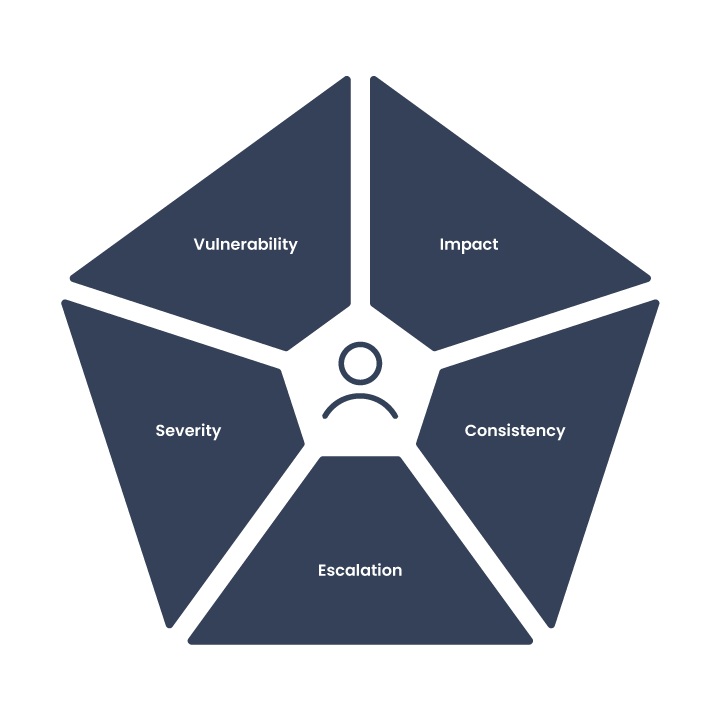
Fathom uses the VICES framework to assess and manage maladaptive behaviours through five progressive dimensions. This is not a moral ladder. It is a diagnostic tool that helps you understand where a behaviour sits on the spectrum from manageable indulgence to genuine harm.
Vulnerability: Where Do Vices Emerge?
Vulnerability refers to the conditions under which a behaviour is most likely to appear — emotional states, environmental cues, fatigue, stress, and social context. Vices do not emerge randomly. They emerge where capacity is low and pressure is high.
Research on ego depletion by Baumeister and colleagues, though debated in its original formulation, has been refined into a more nuanced understanding: self-regulatory capacity fluctuates based on sleep, stress, cognitive load, and emotional state. Understanding your vulnerability patterns — the specific times, environments, and emotional states that trigger compensatory behaviour — is the first step toward managing them. In Fathom, this maps directly to the Forces framework: low Presence creates vulnerability to distraction, low Perspective creates vulnerability to catastrophic thinking, and low Pursuit creates vulnerability to avoidance.
Impact: What Is the Real Cost?
Impact assesses the net effect of a behaviour on your life over time. It asks: What does this give me? What does it take from me? Low-impact behaviours are neutral or containable — they do not meaningfully distort priorities. High-impact behaviours erode focus, wellbeing, or relationships and displace higher-value actions.
Impact determines whether intervention is needed. Not every compensatory behaviour requires correction. Some are manageable, contained, and low-cost. Others are quietly destroying Foundations, eroding Pillar balance, or undermining Principles. The distinction matters — and requires honest assessment rather than reflexive guilt.
Consistency: How Often Does It Happen?
Consistency measures how regularly a behaviour occurs. Occasional indulgence is not a Vice. Repeated reliance is. Warning signals include automatic behaviour without reflection, defaulting under stress, and resistance to interruption.
Consistency reveals dependency, not severity. A behaviour that occurs daily at low intensity may indicate a deeper pattern than one that occurs rarely at high intensity. Research on behavioural patterns by Wendy Wood, published in Annual Review of Psychology, found that the most entrenched behaviours are those that have become automatic responses to environmental cues — precisely the pattern Fathom's tracking system is designed to make visible.
Escalation: Is It Getting Worse?
Escalation is the shift from conscious use to increasing intensity, duration, or frequency. It shows up as needing more for the same effect, longer sessions, or stronger stimuli. Escalation indicates the behaviour is now regulating emotion, avoiding discomfort, or numbing awareness rather than providing genuine relief.
This is the critical intervention point. A behaviour that is escalating is moving from a manageable pattern toward a potentially harmful one. In Fathom, escalation is tracked over time — not through daily guilt, but through pattern recognition that reveals trends invisible in day-to-day experience.
Severity: How Much Harm Is It Causing?
Severity assesses the depth and breadth of harm caused by the behaviour — health impact, professional damage, relational strain, and loss of agency. Severity does not imply addiction by default. It signals priority and urgency.
When severity is high, the response shifts from moderation to more structured intervention. Fathom is clear about its boundaries: the Vices tracker is a diagnostic tool for self-aware professionals managing everyday compensatory behaviours. When severity reaches levels that suggest clinical dependency, Fathom recommends professional support — the system is designed to complement, not replace, clinical care.
Vices as System Signals: What Your Behaviour Is Trying to Tell You
This is the most important insight in Fathom's Vices framework: vices usually point to problems elsewhere in the system. The vice itself is the symptom. The cause is almost always an unmet need, a neglected domain, or a structural weakness that the behaviour is attempting to compensate for.
Excessive distraction (compulsive phone checking, endless scrolling, tab-hopping) typically signals low Presence — an inability to be engaged with the current moment, often driven by anxiety, boredom, or avoidance of difficult emotional states.
Compulsive productivity (overwork, inability to stop, working during rest periods) typically signals a weak Wellbeing Pillar or absent Recreation Pillar — using work as escape from emptiness, relational difficulty, or existential anxiety. It can also signal a Principle gap: no governing rule that protects rest with the same discipline applied to output.
Overconsumption (overeating, overspending, excessive media consumption) typically signals weak Recreation or Connection — a deficit of genuine renewal or meaningful human contact, compensated through consumption that provides temporary comfort but no lasting satisfaction.
Avoidance behaviours (procrastination, chronic delay, withdrawal from challenge) typically signal unclear Purpose or brittle Perspective — difficulty engaging with tasks that feel meaningless or challenges that feel threatening to identity.
In Fathom, the response to a vice is not suppression. It is rebalancing. Address the underlying signal, and the compensatory behaviour often reduces naturally — because the need it was serving is being met through healthier channels.
Moderation, Not Elimination
Fathom is not abstinence-driven. The objective is awareness, choice, and control. This positions Fathom against the moralistic strain in personal development that treats every imperfection as a failure to be eradicated.
Moderation is achieved when the behaviour is conscious (you know when you are doing it and why), frequency is intentional (you choose how often rather than defaulting), and impact is contained (the behaviour does not meaningfully undermine your Values, Principles, or Pillar balance).
Elimination is only relevant when severity is high and agency is compromised — when the behaviour has crossed from a manageable pattern into something that genuinely threatens health, relationships, or professional function. Research on harm reduction approaches by G. Alan Marlatt, published in Clinical Psychology Review, has demonstrated that moderation-based strategies produce better long-term outcomes than abstinence-only approaches for the majority of sub-clinical behavioural patterns — the exact population Fathom is designed to serve.
How Vices Connect to the Rest of the System
Habits are the direct counterpart to Vices. Where Habits represent what you are building intentionally, Vices represent where you are compensating or avoiding. Together, they form the complete behavioural picture — the only layer in Fathom where truth is tracked. A person who logs strong Work Habits but escalating evening screen time is seeing the full reality of their execution, not just the flattering half.
Traits influence vulnerability patterns. High Neuroticism creates higher susceptibility to stress-driven vices. Low Conscientiousness creates vulnerability to impulsive behaviours. High Openness can produce "possibility addiction" — compulsive novelty-seeking that functions as avoidance of depth. Understanding your trait profile helps predict which vice patterns you are most susceptible to.
Values are often the source of the discomfort that vices numb. A professional whose daily work violates their intrinsic values will seek relief — and that relief frequently takes the form of compensatory behaviour. Addressing the value misalignment directly is more effective than suppressing the vice it produces.
Principles provide the governing structure for managing vices. A principle like I do not use comfort to avoid difficulty directly addresses avoidance-based vices. Principle gaps — areas of decision-making where no explicit rule exists — are among the most common underlying causes of vice patterns.
Forces are the primary diagnostic tool for interpreting vices. Low Presence produces distraction vices. Low Purpose produces escape vices. Low Perspective produces catastrophising and the compensatory behaviours that follow. Low Pursuit produces avoidance vices. Force diagnosis tells you why the vice exists.
Pillars reveal which life domains are being neglected — and Pillar neglect is one of the most reliable predictors of vice escalation. When the Recreation Pillar collapses, the mind seeks artificial renewal. When the Connection Pillar collapses, consumption fills the relational void. Pillar analysis identifies what the vice is compensating for.
Foundations can create the conditions where vices thrive. Depleted Resources produce survival-mode decision-making where long-term considerations are overridden by immediate relief. Eroded Relevance produces anxiety that fuels compensatory behaviours. Weak Foundations make vices structurally predictable rather than surprising.
How to Work With Your Vices: A Practical Guide
Step 1: Name Them Honestly. Identify the behaviours that function as Vices in your life — not by comparing yourself to an ideal, but by applying the five criteria. What provides short-term relief at long-term cost? What escalates under stress? What resists moderation despite awareness? Fathom's Vices tracker provides the structured framework for this honest inventory.
Step 2: Map the Triggers. For each Vice, identify the vulnerability pattern. What emotional state precedes it? What environmental cues trigger it? What time of day does it typically occur? Research on implementation intentions by Peter Gollwitzer has shown that identifying specific trigger conditions is essential for behaviour change — you cannot modify a pattern you have not mapped.
Step 3: Diagnose the Underlying Signal. Use the system signal framework: which Force is low? Which Pillar is neglected? Which Foundation is weak? Which Principle is missing? The vice is not the problem. It is pointing to the problem. Address the cause, and the compensatory behaviour often resolves naturally.
Step 4: Design a Replacement, Not a Removal. Rather than eliminating the vice through willpower, design a Habit that addresses the same underlying need through a healthier channel. If the vice is compulsive scrolling driven by low Presence, the replacement might be a five-minute breathing practice that delivers genuine calm rather than temporary numbing.
Step 5: Track and Evaluate Without Judgement. Use Fathom's Vices tracker to record patterns over time. The goal is not zero vices — it is trend awareness. Are vices escalating or stabilising? Are they responding to the system adjustments you have made? The tracker is a diagnostic instrument, not a punishment tool. It replaces shame with data and creates the space for conscious choice.
Start Understanding Your Vices
The Vices framework is one component of Fathom's integrated personal operating system — a structured approach to self-understanding, intentional living, and behavioural evidence for mid-career professionals navigating complexity. Vices are not failures. They are signals pointing to where the system needs attention. The first step is honest observation without judgement. Explore how Fathom works or get started today.
FAQ
Frequently Asked Questions
About the Author
Dan Ford, Executive Career Coach & Founder of Fathom
Dan Ford is an executive career coach and the creator of Fathom — a personal operating system for mid-career professionals navigating complexity, career uncertainty, and rapid technological change. Drawing on behavioural psychology, self-regulation research, and two decades of experience coaching professionals through high-stakes transitions, Fathom provides the structured self-examination that generic apps and expensive coaching alternatives cannot.
The Framework
Explore the Full System
Explore
Traits
“How am I wired?”
Stable personality tendencies that influence energy, sensitivity, friction, and behavioural defaults. Based on the Five-Factor Model.
Read moreValues
“What actually matters?”
The enduring priorities that determine what feels meaningful, what motivates effort, and how fulfilment is evaluated.
Read morePrinciples
“How do I choose to act?”
Explicit decision rules that govern behaviour when values conflict, pressure is high, or clarity is missing.
Read moreEvaluate
Forces
“How is life actually being lived?”
Four dynamic conditions – Presence, Purpose, Perspective, Pursuit – that rise and fall depending on attention, choices, and circumstances.
Read morePillars
“Where is life happening?”
Six domains – Work, Wellbeing, Wealth, Recreation, Connection, Environment – that reveal allocation of energy and domain imbalance.
Read moreFoundations
“Is growth structurally possible?”
Four structural enablers – Relevance, Reputation, Relationships, Resources – that determine whether effort is viable.
Read moreExecute
Goals
“Where am I heading?”
Direction, not identity. Goals clarify intended movement. They are optional within the system – they prevent stagnation, but they do not define you.
Read moreProjects
“How am I actually going to get there?”
The structured layer between aspirational goals and daily behaviour. Projects turn direction into a credible plan — with defined initiatives, allocated time, and priority tasks.
Read moreHabits
“What am I doing, repeatedly, on purpose?”
Observable, repeatable, trackable actions. Strategic daily investments that compound over time to shape identity and outcomes.
Read moreVices
“Where am I compensating instead of choosing?”
Behaviours that provide short-term relief while undermining long-term alignment. Not moral failures – signals.
You are hereStop Drifting. Start Building.
Fathom is a personal development system for professionals who take their future seriously. One system. One price. Full access to everything.
Where Are You in the Transition?
Take The AssessmentGet Started for £149 →14-day cooling-off period. Cancel anytime. No tiers. No upsells.
We use analytics cookies to understand how Fathom is used. You can change this at any time on our Cookie Policy page.